

Explore how Strands Agents, LeRobot, and Hugging Face Storage Buckets automate robotic demonstrations, training, and deployment, streamlining operations through a seamless data loop.
The integration of Strands Agents, LeRobot, and Hugging Face Storage Buckets signifies a pivotal shift in the automation of robotic operations. This integration forms a cohesive loop for data streaming and processing, enabling robots to autonomously record, train, and redeploy policies without manual intervention. Such a system offers a model for efficient robotic operation, paving the way for future advancements in autonomous systems.
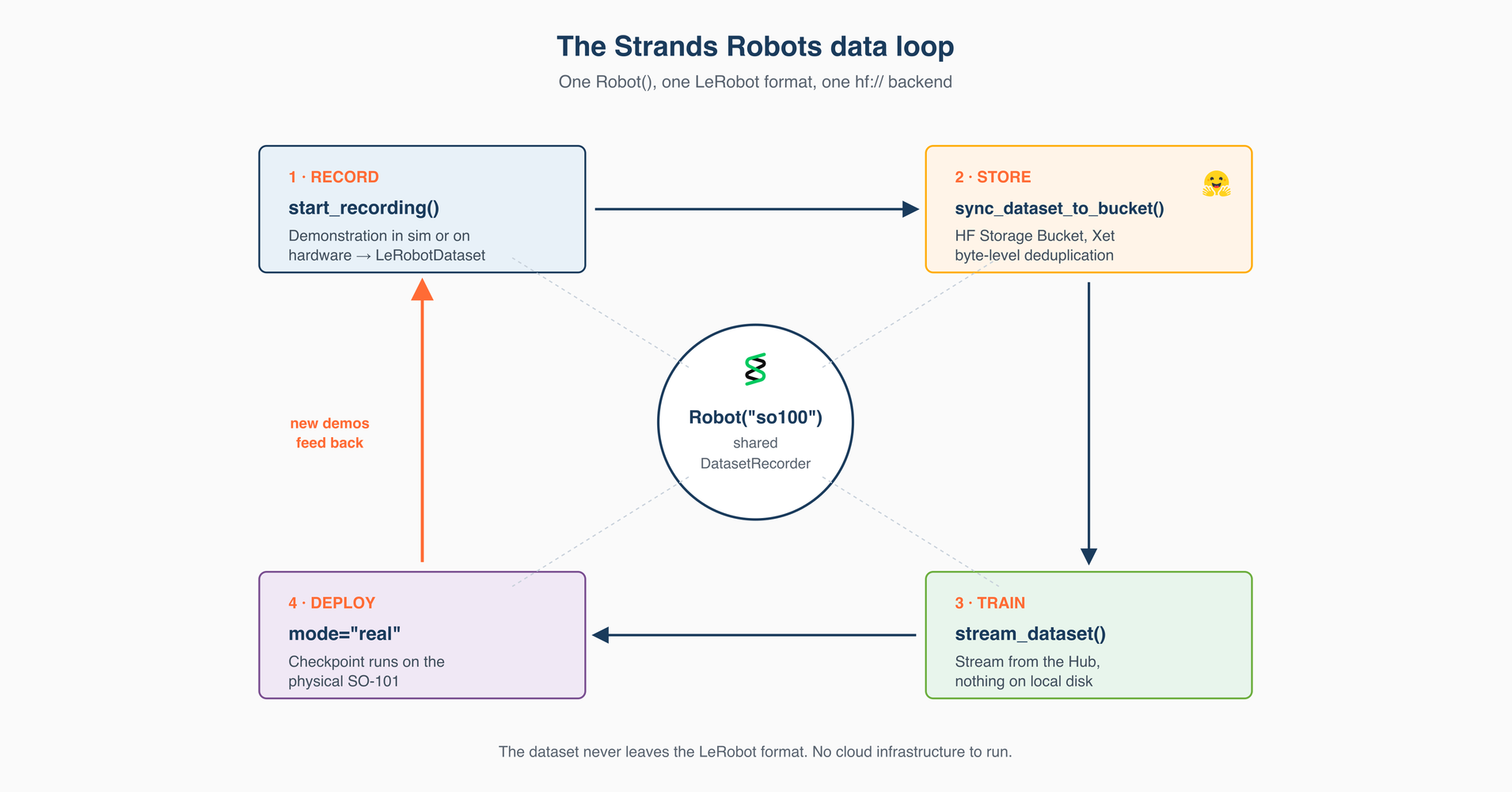
Data Loop for Robotic Operations
At the core of this system is the seamless data loop facilitated by Strands Agents and LeRobot, powered by Hugging Face Storage Buckets. The process begins with the recording of demonstrations, which are immediately uploaded to a centralized repository. The recorded data is stored in an unversioned format that facilitates easy access and modification, crucial for continuous learning and adaptation.
Optimizing Robotic Efficiency
The automation enabled by this system reduces redundant data transfer, a common challenge in continuous robotic applications. By storing only the modified bytes with each sync, the system optimizes bandwidth usage and resource allocation, allowing robotic agents to operate more efficiently. The Hugging Face Storage Buckets provide a mutable working layer, essential for iterative learning processes in robotics.
Real-Time Data and Learning Integration
The ability to train policies in real-time from streaming data without local storage underscores a significant advancement in robotic learning. This not only accelerates the training process but also increases the adaptability of robots to dynamic environments. By transitioning from batch processing to real-time streaming, robots can continuously improve their policies, reacting promptly to new data inputs.
Detected Pattern: Automation Layer
This system represents a clear automation layer, where repetitive human tasks in robotic operations are delegated to intelligent systems. The interaction between software and hardware becomes more fluid, with decision-making and adaptation occurring seamlessly in the background. This pattern exemplifies the shift towards intelligent infrastructure that reduces manual oversight, focusing instead on system-level efficiencies and automation capabilities.
Enhancing Human-Robot Collaboration
As robots become more autonomous through these systems, the role of human operators shifts towards oversight and strategic input rather than direct control. This reflects broader trends in AI and automation, where human interaction with technology becomes less manual and more supervisory, enhancing collaboration between humans and machines.
The deployment of Strands Agents and LeRobot within this automated framework showcases the potential for streamlined and autonomous robotic operations. The integration of real-time data processing and adaptive learning mechanisms signifies a trend towards more intelligent and efficient robotic systems. As these technologies evolve, their application will only broaden, further embedding automation in our digital infrastructure.
Observation recorded.