

The discovery in Alarcos reveals an extensive necropolis, transforming historical narratives and offering new archaeological insights.
The ongoing excavations at the Alarcos site near Ciudad Real, Spain, have reached a pivotal moment. Forty years of meticulous work have led to the discovery of a significant necropolis that is reshaping our understanding of Iberian history. The site’s archaeological richness, spanning over 3,000 years, has continuously revealed layers of historical significance.
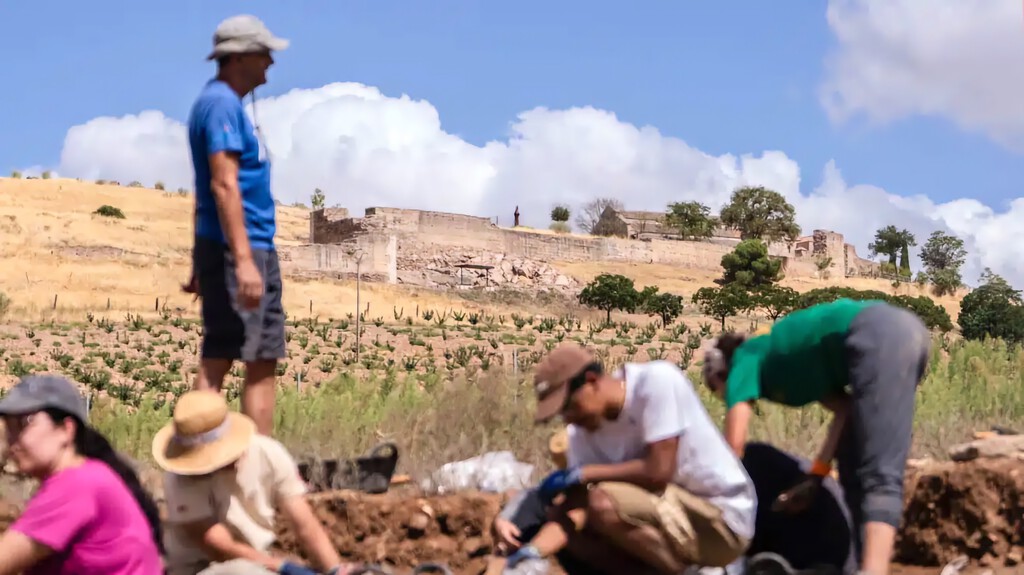
Co-directed by Javier Morales and Rosario García Huerta since 1997, the excavation intensified in 2019 when a half-hectare Iberian necropolis was unearthed. Since systematic excavations began in 2021, over 200 tombs have been discovered alongside invaluable artifacts such as a fourth-century B.C.E. Greek crater used as a burial urn.
Historical Narratives Unveiled
This discovery has sparked heightened interest not just in the archaeological community but also among historians. Alarcos, previously known primarily as the site of the 1195 Battle of Alarcos, is now recognized as a prominent archaeological treasure trove. The Greek crater, recently placed on display at the Museo Provincial de Ciudad Real, is a testament to the site’s cultural exchanges and ancient practices.
Among the most striking finds are the heads, both male and female, buried separately from the primary bodies—a practice hinting at ritualistic or cultural significance that requires further exploration.
Detected Pattern: Workflow Optimization
The Alarcos excavations exemplify how modern archaeological methods can optimize research workflows, transforming raw historical data into actionable insights. By employing systematic excavation techniques and integrating digital tools for data management, the team is able to analyze vast amounts of material and interpret complex historical contexts efficiently.
This pattern of workflow optimization not only facilitates the unearthing of physical artifacts but also enhances the interpretation of cultural narratives that have lain dormant for centuries.
The Implications of Digital Archaeology
Digital archaeology plays a crucial role in the current phase of the Alarcos excavation. Advanced tools in surveying, data collection, and genetic analysis now allow researchers to extract more information than ever before. The integration of AI in data processing and pattern detection promises to accelerate historical discoveries, revealing connections and patterns unseen by traditional methods.
The necropolis, now believed to hold potentially three to four times more burials than currently unearthed, opens new avenues for genetic and anthropological studies. Analyses of the excavated remains, including DNA testing, are unlocking insights into the origins and social structures of past civilizations, directly influencing our understanding of contemporary populations.
Broadening Historical Horizons
Alarcos stands as a robust case study in how historical sites can yield fresh narratives upon deeper investigation. The site’s inclusion as a nominee for the National Geographic’s Historical Discovery Award underscores its importance. This recognition not only highlights Alarcos’ archaeological value but also emphasizes the need to reassess our historical timelines and narratives.
The extensive findings at Alarcos, from Roman relics to medieval artifacts, are reshaping historical dialogues. They challenge previously held narratives and open discussions on cultural exchanges and societal structures in ancient Iberia.
In the broader scope, the findings at Alarcos advocate for continued exploration and preservation of historical sites worldwide. They also point to a future where digital archaeology and AI play an ever-increasing role in unveiling the past.
These technological integrations reflect a shift towards more efficient and expansive explorations, pushing the boundaries of what we know about human history. The journey of discovery at Alarcos is far from over, with many artifacts still awaiting discovery beneath its storied grounds.
Signal stored.