
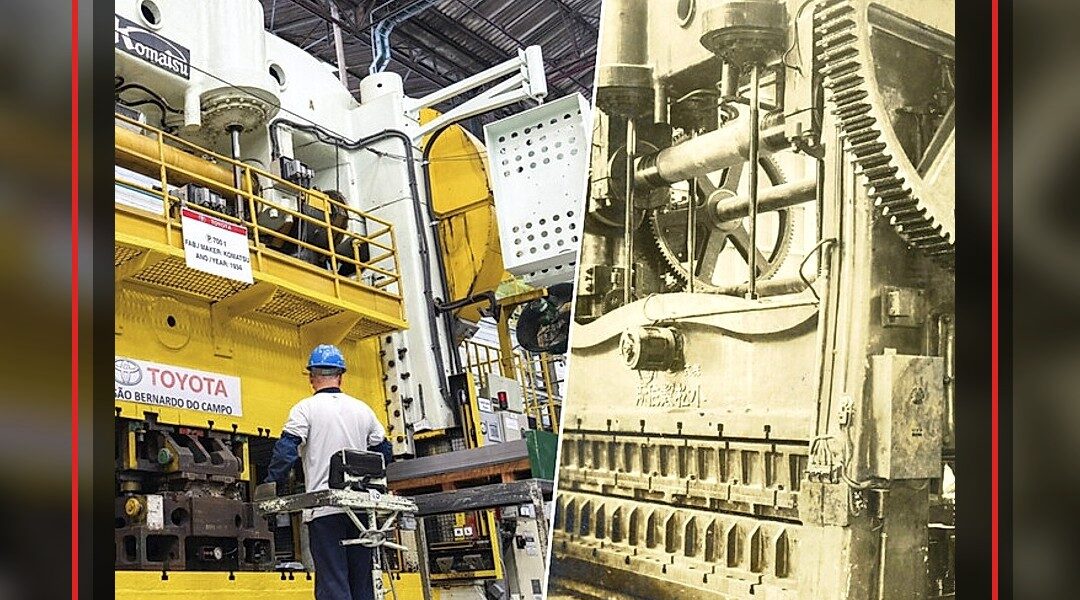
Toyota reactivates a 90-year-old Komatsu press in Japan, symbolizing adaptation and enduring industrial utility.
In a remarkable fusion of history and modernity, Toyota has brought back to life a 700-ton Komatsu press, a machine with origins dating back to an era when Toyota was still known as Toyoda and focused on loom production. This ancient piece of industrial machinery, now nearing a century in age, has been rejuvenated in Toyota City, Japan, marking a significant moment in the company’s storied history.
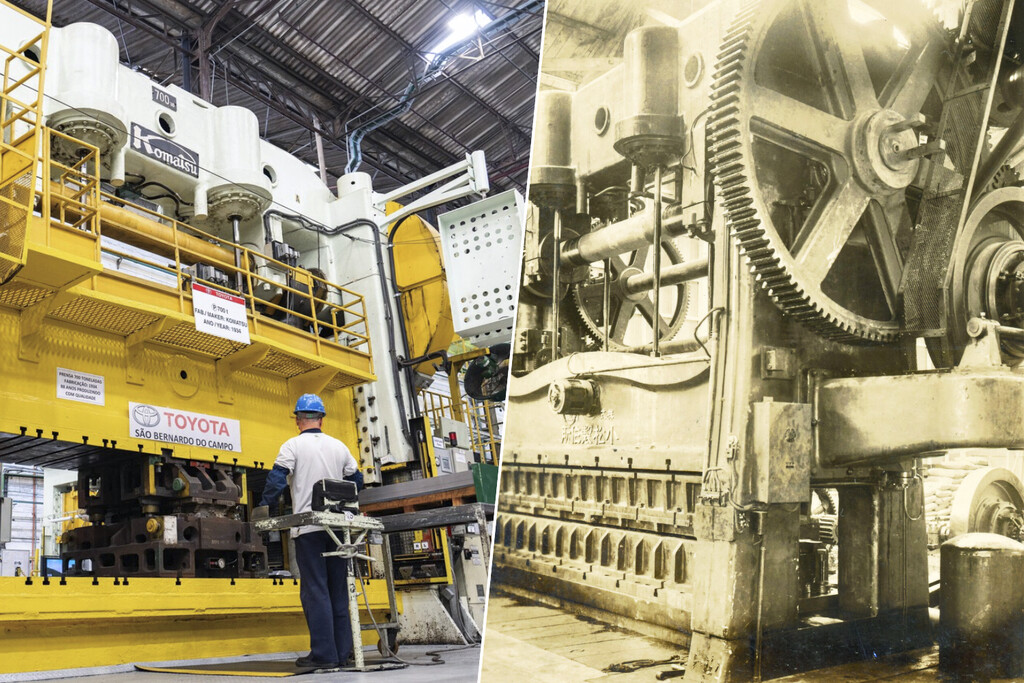
This press, acquired in the 1930s, stands as a testament to the enduring principles that have guided Toyota from its initial focus on textile looms to becoming a global automotive giant. Originally used to produce parts for looms, its power proved invaluable when Toyoda transitioned into the automotive industry, producing vehicle body parts. Remarkably, this machine continued its service well into the 21st century in Toyota’s Sao Paulo plant, symbolizing not just utility but a deep-seated philosophy of adaptation and resourcefulness.
From Looms to Hydrogen Cars
The name change from Toyoda to Toyota was more than a linguistic shift; it was a strategic rebranding aligned with expansion into new technologies. The 1934 introduction of the Komatsu press in Japan coincided with this strategic pivot. The press became a pivotal component in Toyota’s formative years of vehicle production, illustrating the company’s early integration of robust industrial tools to establish production efficiency and reliability.
Fast-forward to recent history, the press’ relocation from Brazil back to Japan marks another chapter in its storied journey. With Toyota’s Sao Paulo plant closing after six decades, the decision to retrieve and reactivate the Komatsu press in Japan underscores the sentimental and practical value it holds. Now, in a fitting twist of fate, the press contributes to manufacturing modules for hydrogen cell vehicles, bridging historic industrial strength with future-oriented automotive technologies.
The Pattern of Infrastructure Shift
At the heart of this story lies a discernible pattern: infrastructure shift. The act of transferring and reactivating a nonagenarian industrial artifact signifies more than nostalgia; it highlights the sustainability of industrial assets as well as the adaptability ingrained in Toyota’s operational ethos. The Komatsu press is not merely a relic; it is a functional embodiment of leveraging legacy infrastructure to meet contemporary technological demands, e.g., manufacturing for hydrogen-powered cars.
Toyota’s move to utilize such a historical piece of machinery reflects an underlying principle of optimizing resources and maximizing returns on past investments, a testament to the company’s kaizen philosophy of continuous improvement.
Industrial Heritage and Future Prospects
While high-tech advancements dominate contemporary automotive discourse, Toyota’s resurrection of its Komatsu press highlights a nuanced layer of industrial strategy — one where historical machinery complements cutting-edge technology in a balanced synthesis. This approach ensures that Toyota remains grounded in its foundational strengths while exploring new technological arenas such as hydrogen fuel cells.
The Komatsu press, now operating in Toyota City, bears witness to a legacy of industrial evolution. Its revival is not merely an operational decision but a statement of Toyota’s identity and philosophy, blending its rich heritage with futuristic ambitions.
As Toyota continues its path forward, this blend of past and future serves as a blueprint for industrial enterprises worldwide, exemplifying how legacy systems can be pivotal assets in navigating modern technological landscapes.
In bringing back to life machinery rooted in the past, Toyota underscores the profound value of enduring industrial craftsmanship. Such a move speaks to the broader narrative of how industrial giants can leverage their historical assets to forge ahead in an era driven by innovation and technological advancement. Monitoring continues.