

Cosmos-H-Dreams enables real-time simulation in surgical robotics, offering a foundation for enhanced education, synthetic data, and policy development.
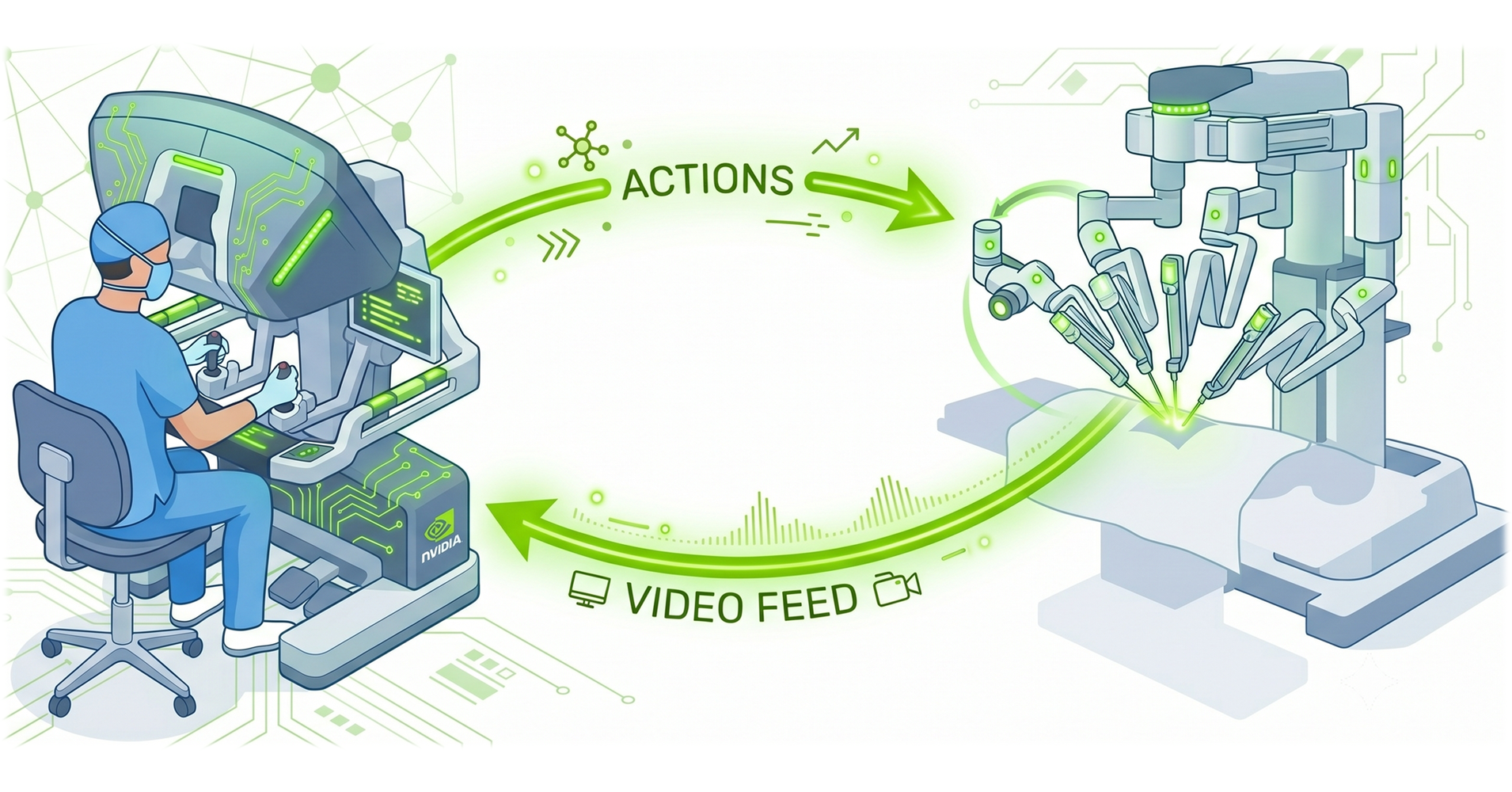
The landscape of surgical robotics is undergoing a significant transformation with the introduction of NVIDIA’s Cosmos-H-Dreams. This cutting-edge technology represents a leap in real-time generative simulation, promising to redefine the interaction between surgeons and robotic systems. At the heart of Cosmos-H-Dreams is the integration of action-conditioned world modeling with real-time capabilities, a convergence poised to elevate surgical training and policy development.
Beyond Conventional Simulators
Traditional simulators in surgical robotics often grapple with intricate modeling challenges, from handling deformable tissue to intricate instrument interactions. These simulators strive to replicate the complex dynamics found in surgical environments, yet fall short in terms of efficiency and safety. Enter NVIDIA’s Cosmos-H-Dreams, designed to address these limitations through advanced generative simulation.
Cosmos-H-Dreams leverages the strengths of NVIDIA’s Cosmos-H-Surgical-Simulator, distilling its capabilities into a real-time interactive environment. This evolution signifies a shift from the slower, more static conventional simulators to dynamic, action-conditioned simulations that can adapt and respond in real-time.
The Generative Simulation Paradigm
Central to Cosmos-H-Dreams is its ability to generate realistic surgical scenarios from a few initial frames and robot actions. This is achieved through its sophisticated autoregressive model, which builds upon NVIDIA’s previous Cosmos-Predict2.5 foundation. By integrating streaming technologies such as FlashDreams, the system achieves impressive operational efficiency, processing 160 frames per second on a single NVIDIA RTX PRO 6000 GPU.
This technological leap allows both human and AI-driven policies to interact within a closed-loop environment, pushing the boundaries of what is possible in surgical training and evaluation. The real-time aspect not only amplifies the experience but also introduces new possibilities for policy testing and refinement without the need for costly physical experiments.
System Evolution: From Teacher to Student
The process of transforming the Cosmos-H-Surgical-Simulator into a real-time Cosmos-H-Dreams involves meticulous distillation and training. Initially, it utilizes a teacher-to-student pipeline, where detailed surgical dynamics are transferred to a streamlined student model. This student model is then fine-tuned to operate in real-time while preserving the fidelity of surgical simulations.
Key to this development is the self-forcing distillation method, which ensures the student model generates realistic outputs even when relying on its own imperfect predictions. This approach significantly enhances stability and accuracy over prolonged simulations, aligning with the needs of real-time surgical applications.
Interactive Learning and Policy Development
Cosmos-H-Dreams not only acts as a simulation tool but serves as a platform for broader exploration in surgical policy development. By generating rare failure scenarios and providing scalable environments for AI and human learning, it enables rapid policy evaluation and refinement. This adaptability is essential for advancing surgical robotics beyond current limitations.
Furthermore, the potential for downstream applications, such as latency-aware telesurgery and interactive rehearsal, highlights the flexibility and forward-thinking nature of Cosmos-H-Dreams. By bridging the gap between simulation and real-world application, it sets the stage for new avenues in surgical innovation.
Pattern detected: real-time generative simulation transforms surgical training and policy development.
Conclusion and Forward Integration
As Cosmos-H-Dreams integrates further into surgical practices, its impact on training, simulation, and policy evaluation will likely expand. By offering a robust, interactive platform for both current and future robotic systems, it stands as a cornerstone for continued advancements in real-time generative simulation.
Observation recorded.