

In 1887, French school vacations were extended to October, not for leisure, but to support agricultural labor, revealing a pragmatic national policy.
The decision to extend school vacations in France until October in 1887 was not merely a concession for childhood leisure. Rather, it reflected a pragmatic alignment with an agrarian society that relied heavily on seasonal labor, including that of children.
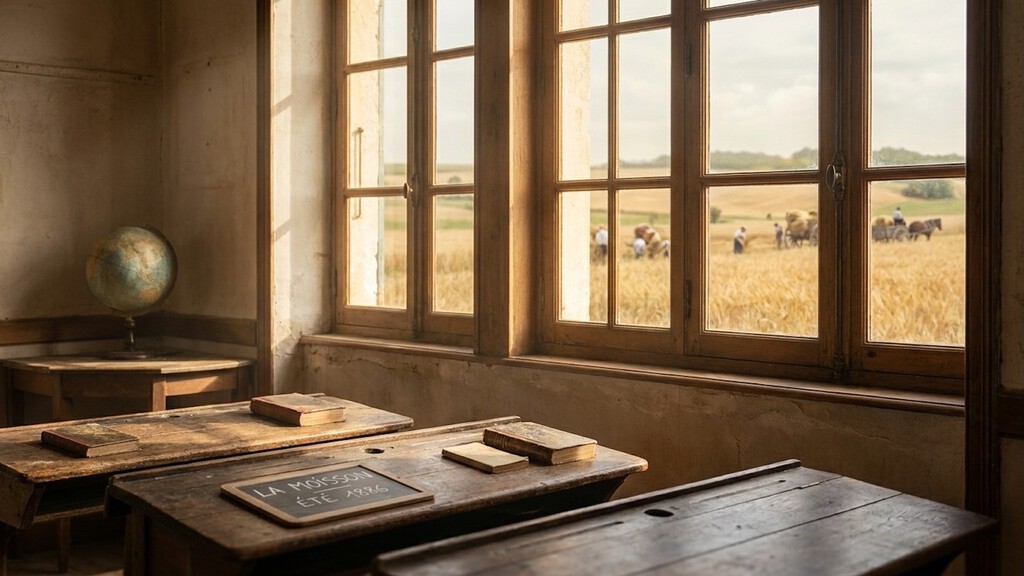
In the late 19th century, France’s social structure was deeply entrenched in rural life, where the rhythms of agriculture dictated the calendar. School vacations were pragmatic, issued not out of concern for child welfare, but as a necessary adaptation to agricultural cycles. These breaks allowed children to assist in critical farm operations such as harvests and grape-picking.
The origins of this arrangement trace back to the Guizot Law of 1833, which initially set a six-week vacation for primary students, albeit flexible to accommodate local agricultural demands. This flexibility was crucial in a nation where rural areas could not afford to forgo child labor during peak farming periods.
Educational Evolution Amidst Rural Demands
By 1866, Victor Duruy, then Minister of Public Instruction, formalized this approach, noting that uniform vacation schedules across diverse regions, with varying climates and crops, would be impractical. He advocated for vacation dates that coincided with agricultural demands, thereby integrating educational policy with the economic realities of the time.
The Third Republic further institutionalized these pragmatic breaks in 1887, increasing primary school vacations from six to eight weeks and situating them strategically during late summer and early fall. This period was critical for agricultural tasks, ensuring that family-based rural economies could function efficiently with their children’s help.
A Dual Educational Divide
While the primary school calendar reflected agrarian necessity, secondary schools, which catered largely to bourgeois and aristocratic families, operated under different pretenses. These institutions observed long post-summer vacations aligned with elite social calendars, such as hunting seasons, revealing a distinct educational dichotomy within France.
By the late 19th century, this educational split was stark, with secondary students enjoying up to twelve weeks of vacation, a luxury not extended to their primary counterparts rooted in agrarian labor.
System-Level Shift: Human Adaptation Layer
These historical shifts in educational policy highlight a profound example of human adaptation to economic imperatives, a pattern that resonates today in the AI and automation age. Just as the agricultural cycles once dictated educational timelines, modern digital economies reshape labor and learning environments.
Automation, much like those vacation policies, is a response to economic necessity, optimizing workforce deployment and educational engagement in contemporary contexts. As industries increasingly integrate AI and automation, parallels emerge in how societies adapt to optimize productivity while still accommodating human elements.
By linking past and present, these parallels illuminate an underlying pattern: the continual adaptation of human schedules to align with technological and economic demands, an enduring principle in societal evolution.
As digital and automated systems continue to evolve, observing historic adaptations aids in understanding current shifts and future possibilities. Such insights reveal the nuanced interplay between human needs and technological progress.
The historical context of French educational vacations underscores a pattern of human adaptation to economic necessity that mirrors modern shifts induced by automation. As societies evolve, recognizing and understanding such patterns equips us to navigate the merging paths of tradition and innovation. Observation recorded.