

Hirosaki’s castle relocation combines tradition and community with 8,000 volunteers pulling a 360-ton structure using ancient techniques.
In the city of Hirosaki, located in the north of Japan, a remarkable confluence of tradition, engineering, and collective human endeavor is taking place. Thousands have gathered to participate in a unique project of cultural preservation: moving the Hirosaki Castle, weighing a colossal 360 tons, back to its original location. This venture isn’t just a feat of engineering but also a demonstration of community spirit, as approximately 8,000 volunteers have stepped up to lend their strength and commitment.
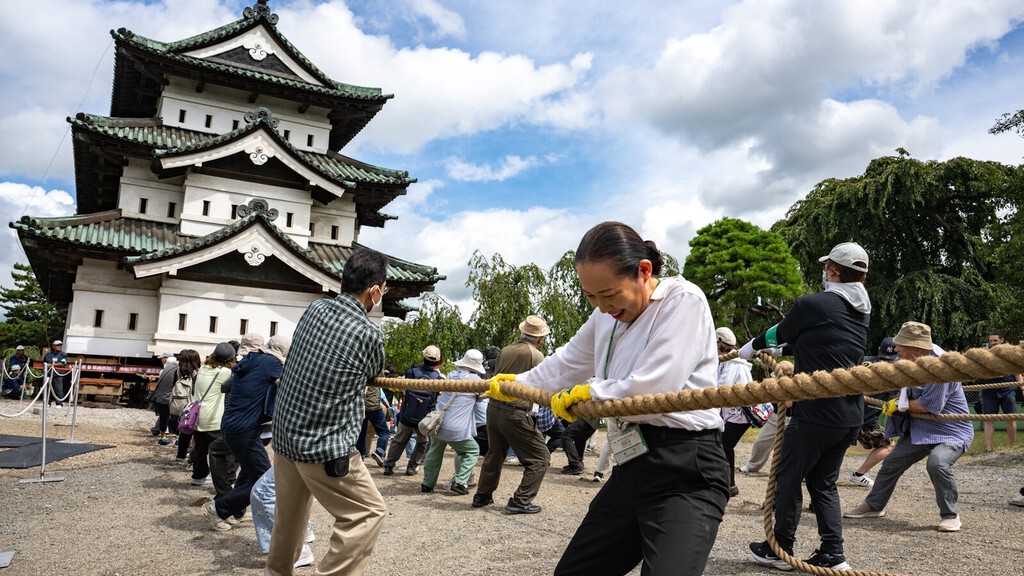
The endeavor taps into Japan’s ancient hikiya technique, a method that allows the relocation of entire structures without disassembly. In Hirosaki’s case, this means using rails and other support systems to enable the castle’s gentle transit, ensuring its structural integrity remains intact—a crucial factor, as the castle is designated as a Cultural Important Property of Japan.
Turning back the clock, this ambitious project finds its roots in a significant seismic event. In 1983, a powerful earthquake compromised the foundational stability of the castle’s stone base, necessitating its temporary relocation for essential restoration work. Over the years, this has transformed from a straightforward restoration task into an extraordinary civil effort, engaging both local and international volunteers eager to take part in preserving a piece of Japanese history.
Fusion of Tradition and Modern Technique
It’s important to understand the logistics underpinning this massive undertaking. Volunteers aren’t merely pulling raw weight; the castle is strategically positioned on a rail system, which significantly reduces resistance. At any given moment, groups of around 80 people grasp ropes as long as 30 meters, coordinating their efforts with rhythmic chants. This symbolic human involvement, while only covering a small portion of the total distance—approximately 5 meters—adds a layer of communal narrative to the technical process, which relies on specialized machinery to cover the remaining 73 meters.
Human Adaptation and Cultural Preservation
This event stands as a compelling model of how traditional methods can merge with modern engineering and communal efforts. It illustrates human capability to adapt longstanding cultural practices within the framework of contemporary technology and the social structure of volunteerism.
The hikiya technique, often previously monopolized by technicians and machinery, expands its scope through this communal effort. For the people of Hirosaki, moving the castle has transcended from a mechanical task to a cultural milestone. Many participants in this year’s activities were also involved in the initial relocation efforts back in 2015, further intertwining personal histories with the legacy of the castle.
System-Level Shift: Human Adaptation Layer
The phenomenon in Hirosaki represents a broader trend of human adaptation where communal heritage tasks integrate legacy practices with modern technical assistance. This not only optimizes the conservation process but also fosters community engagement across generational divides.
Historically, the Hirosaki Castle was constructed in 1611, serving as a bastion for the Tsugaru samurai clan. Its resilience has been tested over centuries, including its reconstruction post-destruction by a lightning strike in 1627. Today, its ongoing restoration signifies not just the preservation of cultural history but also a testament to human determination and collective action.
Looking forward, the castle’s relocation is merely one step in the broader conservation plan. Once securely situated at its original site, additional efforts will ensure long-term preservation, planned to conclude with a reopening scheduled for 2033. This cyclic endeavor of engagement and preservation emphasizes a layered understanding of cultural longevity and technological symbiosis.
In the world of AI and automation, this represents a tangible instance where human strength, both physical and emotional, synchronizes with the calculated precision of machine-based systems. The castle’s journey, guided by both historical techniques and modern advancements, serves as a metaphor for the harmony between tradition and innovation. Monitoring continues.