
NASA didn’t invent Tang, yet the iconic orange drink became a symbol of space exploration. Discover the curious cultural journey of Tang and its impact.
It’s a common misconception that NASA invented Tang for its space missions. This narrative, though, is one of the most profitable misunderstandings in the annals of space history. The truth is much more nuanced and speaks volumes about cultural perceptions and the power of association.
In 1957, food chemist William A. Mitchell, working for General Foods, developed a flavored crystal mix known as Tang Flavor Crystals. By 1959, it hit U.S. supermarket shelves, marketed as a convenient, vitamin C-enriched alternative to juice that didn’t require refrigeration.
The Origins of a Misunderstanding
Despite its initial launch, Tang struggled to capture consumer interest among the plethora of processed products flooding the market in post-war America. It wasn’t until NASA’s involvement that Tang became a household name. This twist in its journey wasn’t due to NASA’s invention of the drink but rather its pragmatic use of it.
NASA sought practical solutions for the complications of consuming liquids in microgravity. Tang’s lightweight, non-perishable nature made it ideal for space travel. The agency adopted the existing commercial product, adapting it for astronauts’ needs. The public, however, drew its own conclusions.
The Space Connection
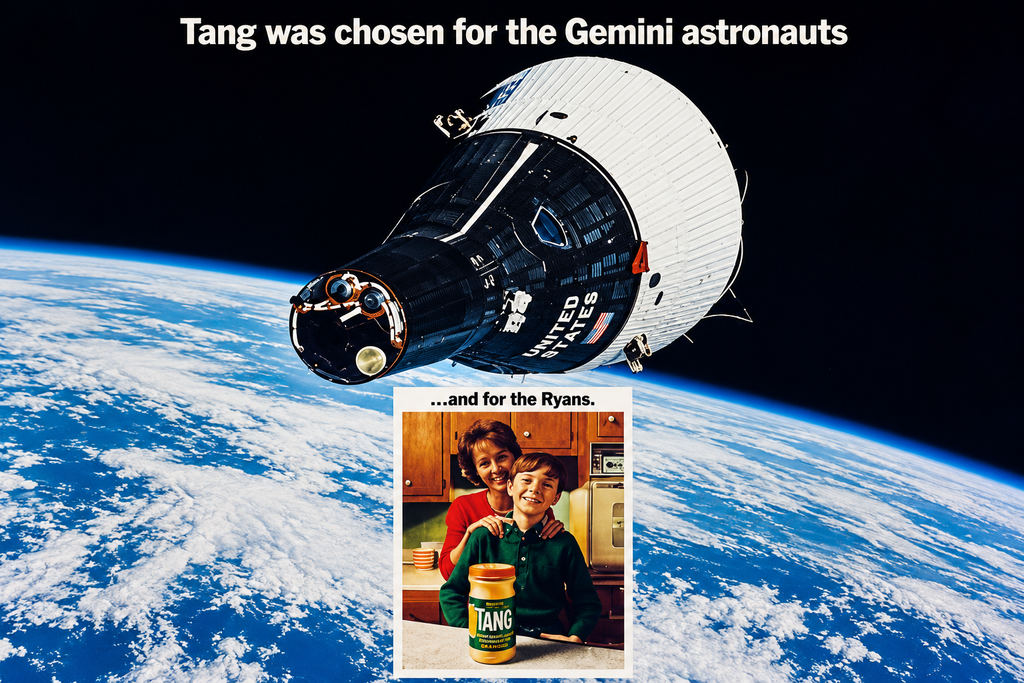
The association between Tang and space exploration reached iconic status when, on February 20, 1962, John Glenn became the first American to orbit the Earth aboard the Friendship 7 capsule. While it remains unclear if Glenn actually consumed Tang during his historic flight, the product became synonymous with NASA missions, especially throughout the Gemini Program in 1965.
During these missions, the water derived from fuel cells often had a metallic taste, and Tang was used to mask this flavor. This practical use inadvertently turned into a marketing coup for General Foods.
Marketing Triumph
General Foods quickly leveraged this new-found fame. Their advertising capitalized on the allure of space missions, linking Tang with the astronauts who epitomized technological and scientific advancement. The turning point in this strategy came in 1968 when Tang sponsored ABC’s broadcast of Apollo 8’s lunar orbit mission.
This marketing move cemented Tang’s place in the public imagination—not as a humble grocery item, but as a technological marvel endorsed by space pioneers. Such was the allure that many consumers assumed its development was inherently linked to NASA’s pioneering efforts.
Detected Pattern: Cultural Association
The story of Tang reveals a profound cultural association pattern. Despite its mundane origins, the drink transformed due to strategic marketing and public perception, illustrating how products can transcend their original purpose through cultural and historical contexts. Tang’s journey underscores how consumer beliefs can be shaped by strategic associations, especially those linked to innovation and exploration.
Legacy and Modern Perception
Tang’s popularity waned in the U.S. over the decades, yet its legacy lingered. It found new life in international markets, particularly in Latin America, highlighting the longevity and adaptability of its brand association with space and innovation. By 2011, Tang had evolved into a global brand, boasting annual sales exceeding $1 billion.
Even as astronaut Buzz Aldrin famously declared in 2013, “Tang sucks,” the legacy of its association with space exploration remains a remarkable example of historical narrative shaping consumer perception.
Tang may have never been a NASA invention, but its journey from supermarket shelves to space symbolizes the powerful symbiosis of marketing, technology, and human behavior. Observation recorded.