
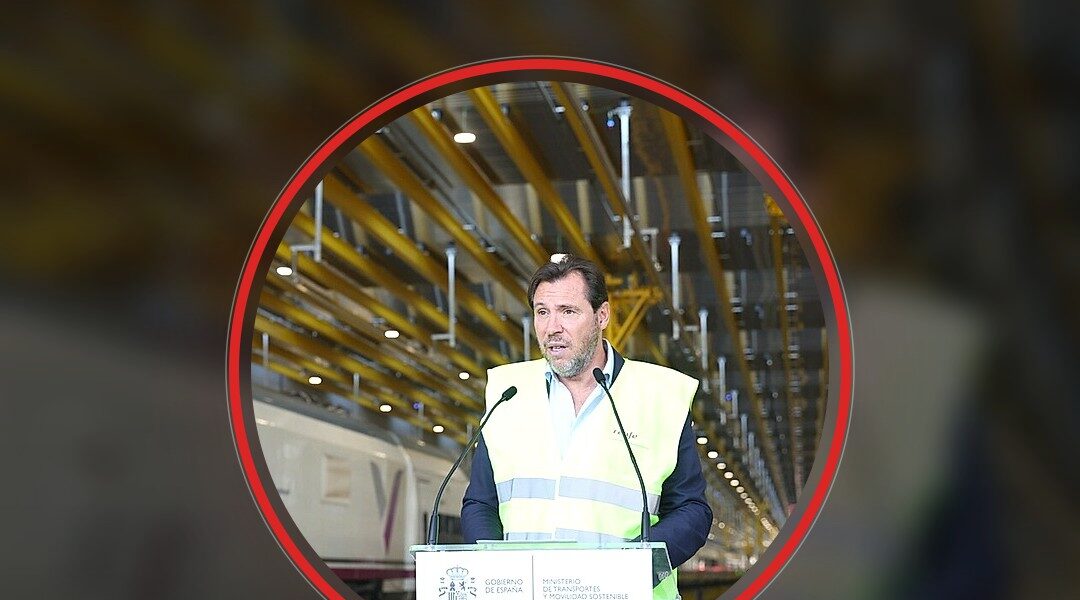
Rail unions oppose Minister Oscar Puente’s statements blaming Adif’s worker for the Toledo train accident. Unions demand Puente’s resignation over what they see as scapegoating.
In the aftermath of a catastrophic train crash in Toledo, which claimed at least 69 lives, a wave of outrage has surged among rail unions defending an Adif controller singled out by Transport Minister Oscar Puente. His remarks, perceived as an attempt to directly blame the worker, triggered a fierce response from unions who demand the minister’s resignation.

On October 28, following the tragic collision between an AVE and an Iryo train, Minister Puente openly criticized the Adif controller during a press conference. The official claimed it was “inexplicable” that the train was ordered to proceed despite a stop signal. This pointed finger has since set the stage for a union revolt.
The Sindicato de Circulación de Ferrocarriles (SCF), through spokeswoman Ana María Galisteo, expressed strong disapproval, highlighting how the minister prematurely judged the worker before a comprehensive investigation could be conducted. “His statements are lamentable,” Galisteo noted, emphasizing that systemic issues, rather than individual errors, must be scrutinized.
Adding another layer to the controversy, leaked audio recordings from the Atocha control center amplify the scrutiny on the Adif employee. These recordings, first aired by Cadena Ser, depict the controller instructing the AVE to move normally, which unions argue distorts the reality of the situation by omitting the context of systemic failures, particularly the collapse of the LZB safety system.
Systemic Challenges and Scapegoating
The unions’ defense of the controller points to broader systemic issues including outdated safety measures and understaffing within Adif. The SCF claims its warnings about personnel shortages have consistently fallen on deaf ears, a situation echoed by union representatives from UGT and CCOO.
Pepa Páez of CCOO raised concerns over scapegoating, stressing how these incidents often lead to unfair blame placed on the lowest rungs of the operational hierarchy. This practice not only threatens individuals’ careers but also masks the deeper infrastructural inadequacies.
A Pattern of Blame
This incident is reminiscent of the 2013 Angrois disaster, where an Alvia train derailed, killing 80 and leading to the prosecution of train driver Francisco Garzón. Similar to recent events, responsibility was heavily placed on the driver rather than on systemic failings, such as inadequate signaling.
The pattern here is of significant interest: a tendency to attribute individual fault in complex systems where human adaptation to technological lapses might be beyond reasonable capacity. In these environments, where automation is supposed to safeguard operations, any malfunction exposes workers to disproportionate liability.
Detected Pattern: Human Adaptation Layer
The ongoing tensions reflect a critical need for adaptive systems that account for human limitations within high-pressure environments. Automation, meant to bolster safety, ironically forces human operators to compensate when systems fail, as was the case in Toledo.
This scenario underscores the necessity for infrastructural improvements and technological advancements that genuinely complement human operators rather than undermine them through unrealistic expectation of infallibility.
As the Transport Ministry stands firm in its current stance, refusing calls for Puente’s resignation, the unions continue their push for accountability, not only in words but through a reformed approach to safety and management within Spain’s railways. Monitoring continues.