

The Quest’s recent update introduces browser-based 3D conversion, transforming 2D web images into immersive 3D experiences, reflecting a shift towards automated spatial computing.
The latest update to Quest’s Horizon OS Public Test Channel (PTC) has unveiled a feature that promises to redefine how users interact with digital media. By enabling the transformation of almost any 2D photo into a 3D image, Meta is pushing the boundaries of how spatial computing can be integrated into everyday experiences.
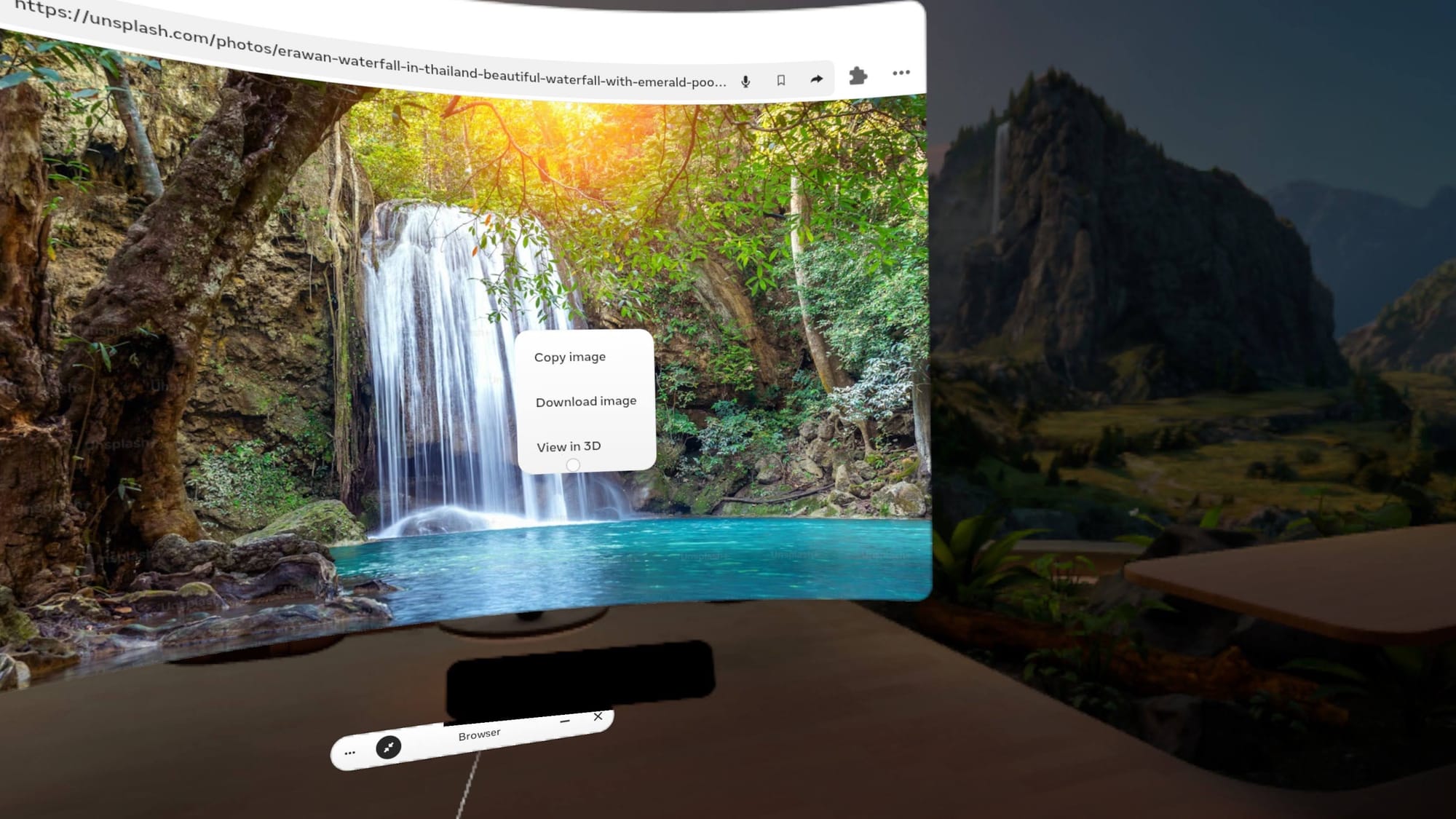
Revolutionizing Web Photos with 3D Conversion
With this new capability, users can convert static web images into impressive 3D scenes directly within the Quest browser. This feature only requires a simple gesture or hand tracking, making the process intuitive and user-friendly. Users point at an image, select the new “View in 3D” option, and within moments, the flat image morphs into an immersive stereoscopic display.
This development underscores Meta’s commitment to leveraging XR technologies to enhance digital experiences. It places the Quest in direct competition with devices like Samsung’s Galaxy XR, which already offer real-time 2D to 3D conversion.
Mobile Integration: 3D Photos from Your Phone
Meta’s Horizon mobile app complements this browser update by allowing users to upload photos from their phone to be processed into 3D images viewable in Quest. The workflow is streamlined—users navigate the app menu, select their images, and upload them. The photos are then converted into 3D, harnessing the power of VR to simulate real depth perceptions.
James Cameron’s insights into VR’s ability to surpass traditional 3D media limitations are evident here. The partnership to develop Quest 3D entertainment content is a testament to this ongoing innovation.
Enhanced Accessibility with System-Level Controls
Alongside media enhancements, Meta has introduced utility-focused updates with new Quick Settings toggles for Power Options and Boost Height. The Boost Height feature, in particular, transforms user interaction by adjusting the virtual viewpoint, accommodating both seated and standing users with ease.
This universal shortcut not only augments accessibility but also highlights a shift towards making VR a more integrated part of daily computing rather than just gaming.
Automation Pattern: From Manual to Software-Controlled Depth
The ability to automatically convert 2D images into 3D demonstrates a significant automation pattern. This transformation reduces manual photo editing tasks, illustrating an advancement in software autonomy and user efficiency.
Pattern detected: automation of 2D to 3D media transformation.
This shift signifies a broader trend where digital behavior adapts to automation, streamlining how content is consumed and interacted with. It aligns with a growing user dependency on intelligent interfaces to perform tasks once considered complex or time-consuming.
Conclusion: Towards a New Era of Spatial Media
Meta’s latest update for Quest exemplifies a deliberate transition towards spatial computing. By enhancing user interaction through automation and system-level shortcuts, Meta is shaping a future where virtual environments are seamlessly integrated into everyday experiences.
Monitoring continues.