

NASA’s pause on the HALO module reflects a shift toward lunar surface missions, altering the trajectory of lunar habitation infrastructure and resource allocation.
In a strategic pivot that underscores NASA’s evolving lunar exploration goals, the agency has instructed Northrop Grumman to cease work on the Habitation and Logistics Outpost (HALO) module. This decision emerges amidst NASA’s broader plan to transition focus from an orbiting Lunar Gateway to a base directly on the Moon’s surface. This shift reflects a significant change in the infrastructure trajectory for lunar habitation.
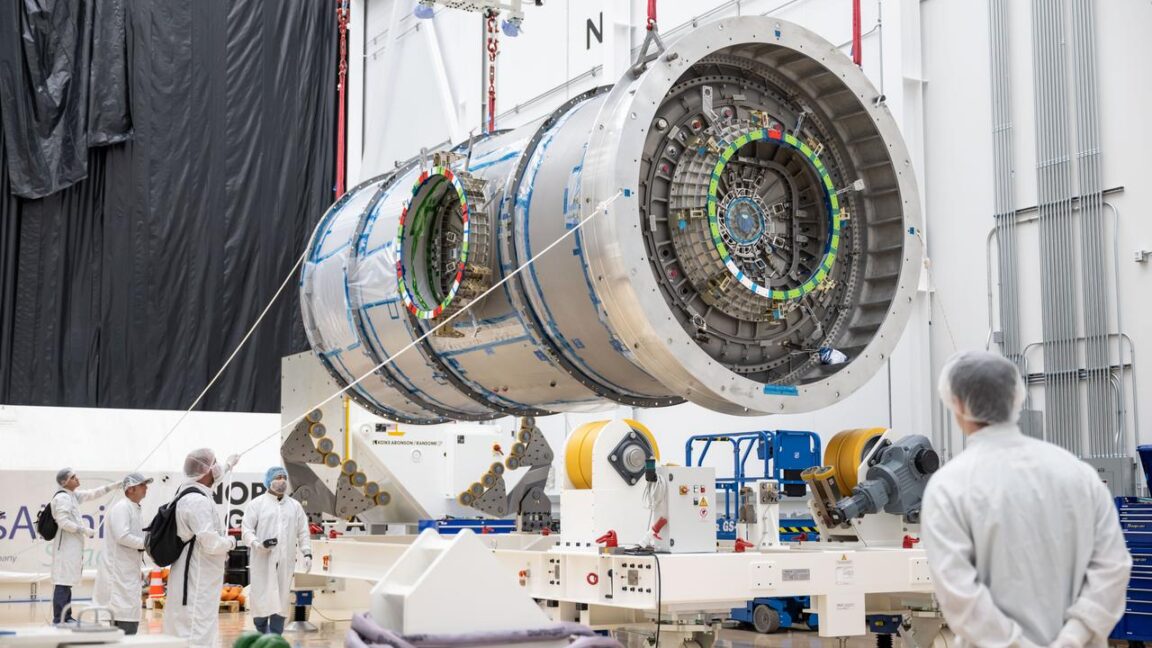
The HALO module, a 6.1-meter long pressurized habitat, was a key component of the Lunar Gateway, intended for astronaut use during lunar orbit missions. An investment of $1.1 billion had been allocated for its integration with the Power and Propulsion Element. Despite this, the project is unlikely to continue in its original form as NASA turns its attention to different priorities, notably the establishment of a Moon base.
Reassignment and Resource Allocation
Following the March announcements regarding these shifts, Northrop Grumman lobbied to include HALO in the lunar surface initiatives. However, recent developments suggest this integration will not occur. Employees affected by this halt are being reassigned within Northrop Grumman’s space portfolio, indicating a redirection of expertise and resources to more relevant projects under NASA’s new strategy.
Pattern detected: infrastructure shift towards lunar surface missions.
Despite the cessation of HALO production, the relationship between NASA and Northrop Grumman remains stable. Sources confirm that the agency and its contractor have reached agreeable terms for redirecting their contributions to the Moon base initiatives. This reflects NASA’s adaptable approach to leveraging existing partnerships despite changing mission priorities.
Implications of the HALO Halt
Several factors could have influenced the decision to pause HALO development. First, the unit’s fully outfitted mass of 8 to 9 metric tons poses logistical challenges for lunar surface deployment. This aligns with a conservative ‘walk-before-you-can-run’ philosophy, where NASA prioritizes manageable, scalable hardware for lunar endeavors.
Additionally, technical challenges such as corrosion issues might have increased the time and cost of remediation, influencing NASA’s strategic decision. Such risks could have contributed to halting the project in favor of more viable alternatives.
System-Level Shift
The cessation of HALO work underscores a broader pattern within space exploration infrastructure: a shift from orbital to surface-based systems. This pivot signals NASA’s commitment to direct lunar surface engagement, demanding new approaches to habitation modules and supporting technologies. The HALO module, while mature, appears misaligned with this emerging framework, emphasizing a need for revised resource allocation and technological adaptation.
Furthermore, this infrastructural shift illustrates a recalibration of objectives. By focusing on a direct surface base, NASA aims to optimize its strategic goals, redirecting resources towards sustainable in-situ development rather than transitional goals such as lunar orbit outposts.
Future Prospects and Continuation
As Northrop Grumman and NASA recalibrate their efforts, the cessation of HALO work serves as a case study in adaptive management within space exploration. This realignment not only marks a deviation in project timelines but also catalyzes new technological directions.
The HALO halt does not signify the end of lunar ambitions, but rather an evolution towards more sustainable and scalable mission frameworks. As NASA continues to adapt its infrastructure and resource strategies, the agency remains focused on long-term lunar surface presence, indicative of a more cohesive and pragmatic exploration roadmap.
Monitoring continues. Signal stored.