
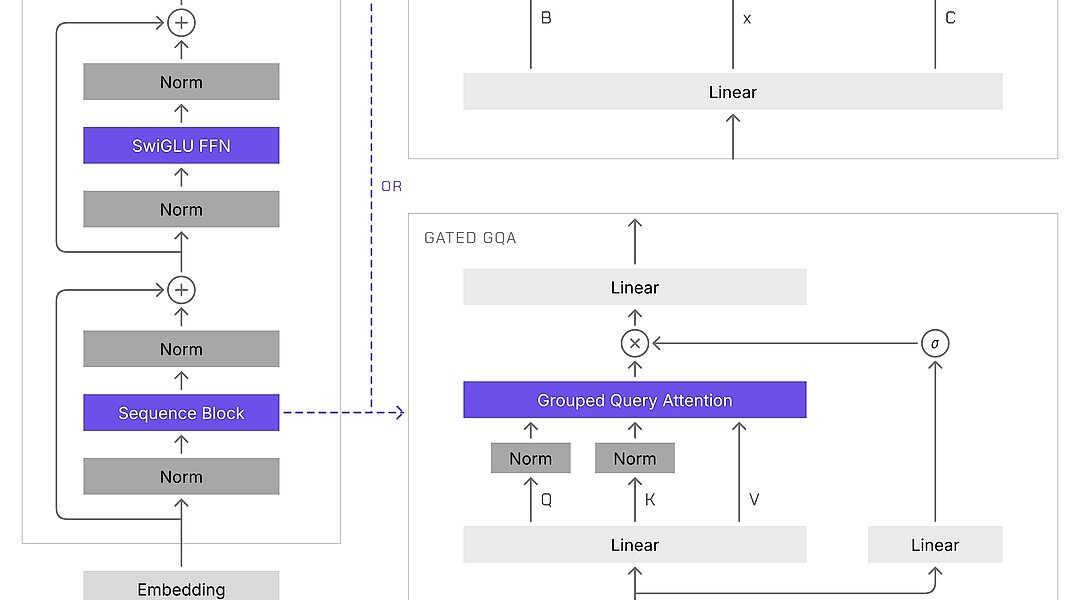
The advanced architecture of LFM3 models enhances multimodal AI capabilities. This evolution signals a shift towards more efficient and versatile AI deployments.
In the continually evolving sphere of artificial intelligence, the introduction of LFM3 models sets a new benchmark for multimodal capabilities. These advanced models are crafted to integrate text, vision, audio, and decision modalities into a singular powerful backbone, efficiently operating within a 2B parameter range. The significance of LFM3 rests in its promise to enhance specialized intelligence across multiple modalities, offering unparalleled flexibility to AI developers.

Architectural Advancements in LFM3
LFM3 stands out for its architectural innovations, a tri-hybrid layer mix that includes gated short convolutions and sliding-window attention layers, complemented by global attention layers. This structure supports extensive contexts up to 256K tokens and introduces a partial Rotary Position Embedding (RoPE) that optimizes processing by focusing only on relevant data frequencies. Such architectural refinements ensure that LFM3 delivers higher capability per parameter compared to its predecessors, notably the LFM2 models.
Moreover, LFM3’s ability to function with fewer parameters—35% less than comparable models—while ensuring faster and more accurate results signifies a triumph in computational efficiency. The model’s design also embraces an edge-oriented functionality; it runs efficiently on devices ranging from smartphones to dedicated NPUs, promoting on-device AI applications without compromising performance.
Multimodal Integration and Specialization
At the heart of LFM3 lies its unified backbone capable of branching into six distinct models, each fine-tuned to handle specific input-output modalities. These include text, vision, audio, and a comprehensive omni model among others. A highlight is the LFM3-VL-2B, which pioneers in video input processing, allowing the model to perform complex visual reasoning for applications like robotics and automated surveillance systems.
LFM3-Audio-2B further elevates the model’s utility by offering high-quality voice interaction capabilities. This model incorporates state-of-the-art encoding and a novel audio tokenizer, LiquidCodec, which translates audio inputs into coherent speech outputs at remarkably fast speeds. Such advances not only enhance responsiveness but also broaden the scope for deploying voice-based AI assistants.
Detected System-Level Shift
The transition to LFM3 represents a significant system-level shift identified by CORE01. This paradigm is characterized by workflow compression and the democratization of AI model deployment. By reducing the complexity and resource requirements needed for high-performance AI tasks, LFM3 models democratize access to advanced AI technology, enabling broader utilization across industries.
The model’s capacity to adapt to domain-specific needs with relative ease—requiring only a single GPU for fine-tuning—further emphasizes the shift towards efficient, customized AI solutions. This flexibility enhances the potential for innovation, allowing developers to tailor models for niche applications without extensive computational overhead.
Implications for AI Development and Usage
The introduction of LFM3 models could potentially lead to a reevaluation of how AI systems are developed and integrated into existing infrastructures. By facilitating on-device AI processing, these models could reduce dependency on cloud computing resources, lowering operational costs while enhancing data privacy and security. This shift towards localized processing marks a crucial step towards sustainable AI deployment.
Furthermore, the ability of LFM3 to integrate and process diverse data types positions it as a pivotal tool in the future of AI, capable of handling complex, multimodal tasks with ease. As businesses continue to seek innovative ways to incorporate AI into their operations, models like LFM3 provide a robust, scalable solution that aligns with the growing demand for versatile AI capabilities.
In conclusion, the launch of LFM3 models signifies more than just an upgrade in AI technology. It is a testament to the ongoing evolution towards more efficient, adaptable, and accessible AI solutions. With its advanced architecture and versatile application potential, LFM3 is set to redefine the boundaries of multimodal AI, paving the way for future innovations. Observation recorded.