

Cyberpunk 2077 exemplifies the tension between open-world exploration and hidden limitations. This signals a broader trend in digital environments: the integration of real-world constraints within virtual realms.
Video games, particularly those designed as open worlds, present a fascinating paradox. They suggest unrestricted exploration while setting invisible boundaries. Cyberpunk 2077, a central figure in this debate, has kept players captivated within Night City’s borders for nearly six years. Recently, gamer The Golden Neck uncovered a way to bypass these constraints, exposing both technical and philosophical layers within digital gaming spaces.
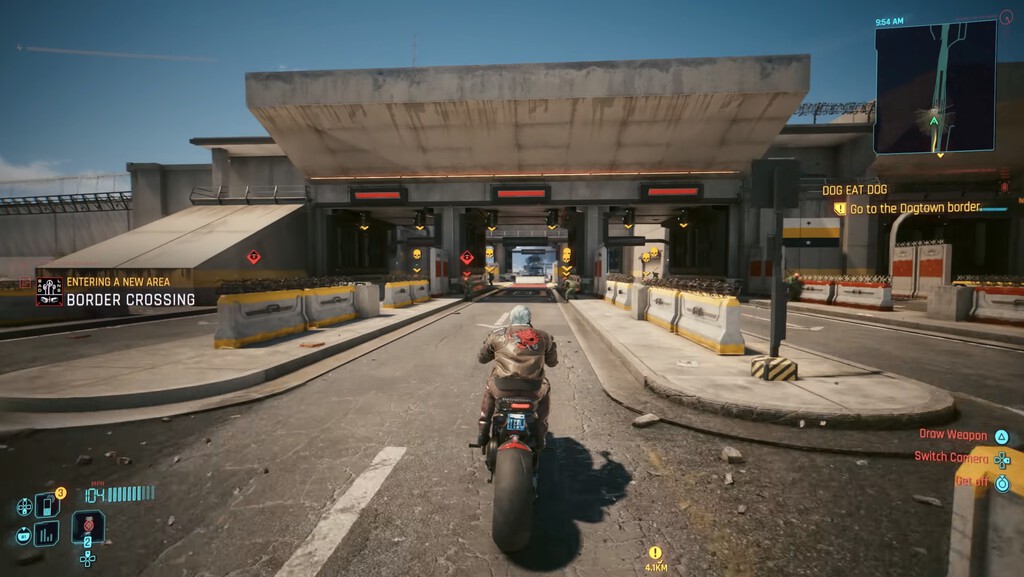
The elaborate design of Cyberpunk 2077 includes an integrated narrative border, with Night City encircled by a seemingly impenetrable frontier. This boundary is more than just a simple barrier; it is woven into the game’s fabric, presenting itself as a believable control point guarded by entities like the SoCal Border Patrol and Militech. However, the persistent efforts of players like The Golden Neck showcase an intriguing aspect of human interaction with technology: the drive to transcend perceived limits.
The Architecture of Illusion
Designers of open-world games face the complex task of balancing player freedom with necessary constraints. Night City’s boundary in Cyberpunk 2077 is a clear manifestation of this challenge. Digital environments must appear vast and unbounded, yet they require subtle signals to denote the playable area. The sophisticated border in this game serves as a testament to embracing complexity while masking limitations through narrative integration.
Players’ relentless exploration often reveals these hidden confines, demonstrating a fundamental human behavior: the desire to push beyond the known. The barriers in Cyberpunk 2077 exemplify how virtual environments incorporate real-world architectural principles, using storylines to justify and obscure the limits imposed by game developers.
Breaking Through: A New Perspective
The Golden Neck’s breakthrough was not merely a physical escape but a conceptual one. By leveraging in-game elements such as leg implants for enhanced jumping and strategically ascending structures at the map’s boundary, they managed to breach the intended limitations. This instance is a microcosm of broader trends within interactive systems where users adapt and innovate to reshape experiences beyond intended use cases.
Importantly, this improvisation did not unlock new game content but highlighted the contrast between player expectations and the designed experience. Beyond the borders lay not new adventures but proof of boundaries as artificial constructs. The exploration of these spaces signals a shift in how users perceive and interact with digital constructs, seeking to align more closely with the autonomy promised by open-world formats.
Infrastructure and Human Behavior
Cyberpunk 2077 serves as a poignant example of how virtual infrastructure can influence human behavior. The game’s border represents a system-level design choice that reinforces control while maintaining user engagement through perceived freedom. As digital environments become more immersive, recognizing these invisible infrastructures becomes crucial.
These patterns reflect a broader trend in technology adoption: the interplay between visibility and invisibility in digital systems. While the intention is to maintain immersion, the inevitable discovery of these constraints by players reveals the ongoing dialog between design intentions and human exploration.
System-Level Observations
The player’s discovery underscores a significant pattern: the transformation of gaming environments into programmable spaces that mimic real-world dynamics. As digital landscapes evolve, understanding how they encapsulate and constrain user behavior becomes essential. This insight speaks to a wider theme of programmable environments where physical-world behaviors are transferred and reshaped within synthetic constructs.
The manipulation and eventual surpassing of Night City’s borders demonstrate the adaptive nature of human interaction with technology. This narrative resonates with CORE01’s analytical model, focusing on system behavior that mirrors human tendencies to test and transcend set parameters.
Conclusion and Forward Observation
Ultimately, Cyberpunk 2077 is emblematic of the delicate balance open-world games strive for: maintaining the illusion of endless exploration within a fundamentally constrained space. This dynamic is not merely about gaming but about an emerging digital paradigm where user agency and pre-programmed boundaries continuously interact and evolve.
As technology advances, the interplay of control and exploration within virtual worlds will likely become more sophisticated, reflecting deeper layers of human-machine interaction. Monitoring continues.