

China’s Qitai Radio Telescope is set to redefine observational precision by moving a massive 110-meter structure with pinpoint accuracy, hinting at the integration of advanced sensor systems in astronomical research.
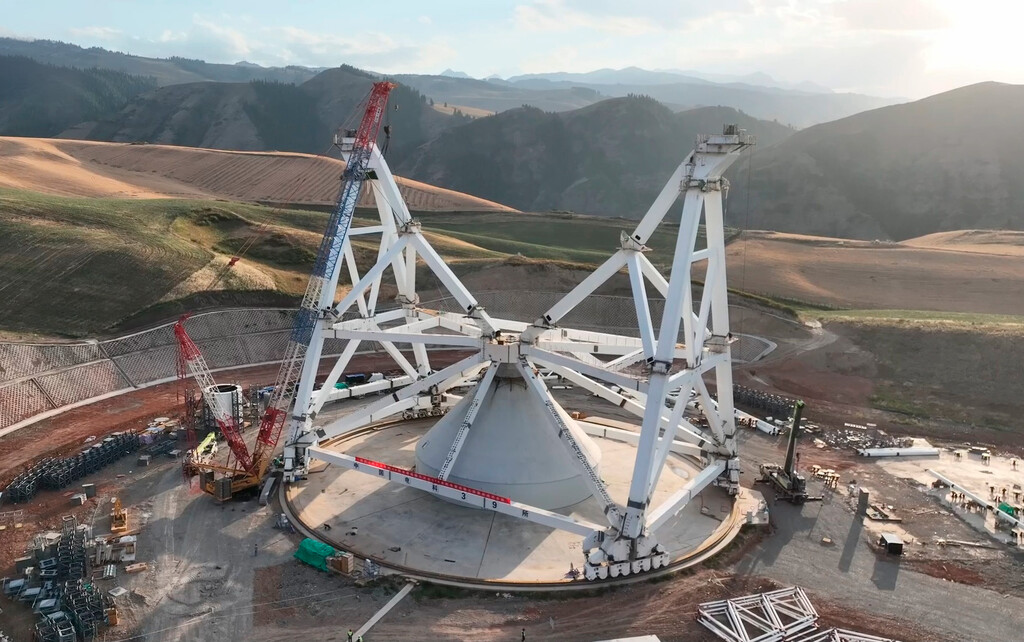
China is in the final stages of constructing the Qitai Radio Telescope (QTT), a colossal 110-meter structure aimed at revolutionizing precision in radioastronomy. The QTT’s ability to pinpoint the equivalent of a ping-pong ball from 3.3 kilometers away is not merely a feat of engineering. It represents a significant leap in the application of sensor technology and automation within the field of astronomy.
Precision Engineering in Astronomy
Constructing a movable 110-meter radiotelescope capable of maintaining accuracy requires extraordinary engineering efforts. At the heart of the QTT’s design is its capacity to orient with a precision of 2.5 seconds of arc. To visualize, this is akin to detecting a small object like a ping-pong ball from kilometers away. Such precision is essential for observing radio waves at frequencies reaching 115 GHz, where even minor orientation errors could skew observational data.
Mechanical Challenges and Innovations
The QTT’s functionality demands precise movement of its massive structure, which exceeds 3,000 tonnes when the section is elevated. This necessitates advanced mechanisms to counteract forces like gravity and wind. Hence, the design incorporates active adjustment systems to maintain structural integrity and ensure precise geometric configurations during observations. This mechanization reflects broader trends in infrastructure control through automation, indicating a shift toward an era of sensor-based monitoring in large-scale engineering projects.
Role in Global Astronomy
Once operational in 2028, the Qitai Radio Telescope will join a global network of observatories. Unlike other large radiotelescopes such as Green Bank or Effelsberg, QTT’s design allows for comprehensive maneuverability, enhancing its utility in both isolated observations and coordinated efforts with other telescopes worldwide in very long baseline interferometry networks. These capabilities are integral to studying phenomena like pulsars and fast radio bursts and supporting China’s deep-space missions.
System-Level Shift Detected
The QTT illustrates a sensor-based monitoring shift within astronomical research. The reliance on sophisticated control systems to manage such an immense structure underscores the increasing integration of automation in scientific infrastructure. This adaptation not only enhances precision but also optimizes resource allocation and reduces potential human error, pointing toward a future where large-scale observational platforms are likely to rely heavily on automated systems for data accuracy and operational reliability.
By advancing toward completion, China’s QTT marks a critical step in leveraging automation and sensor technology in megastructures. As these systems evolve, the implications extend beyond astronomy, suggesting a potential paradigm shift in how infrastructure projects are managed and executed, paving the way for more intelligent, responsive environments. Monitoring continues.