

As the water levels of the Mansilla reservoir recede, the submerged village of Mansilla de la Sierra emerges, unveiling historical layers and prompting questions about heritage and infrastructure.
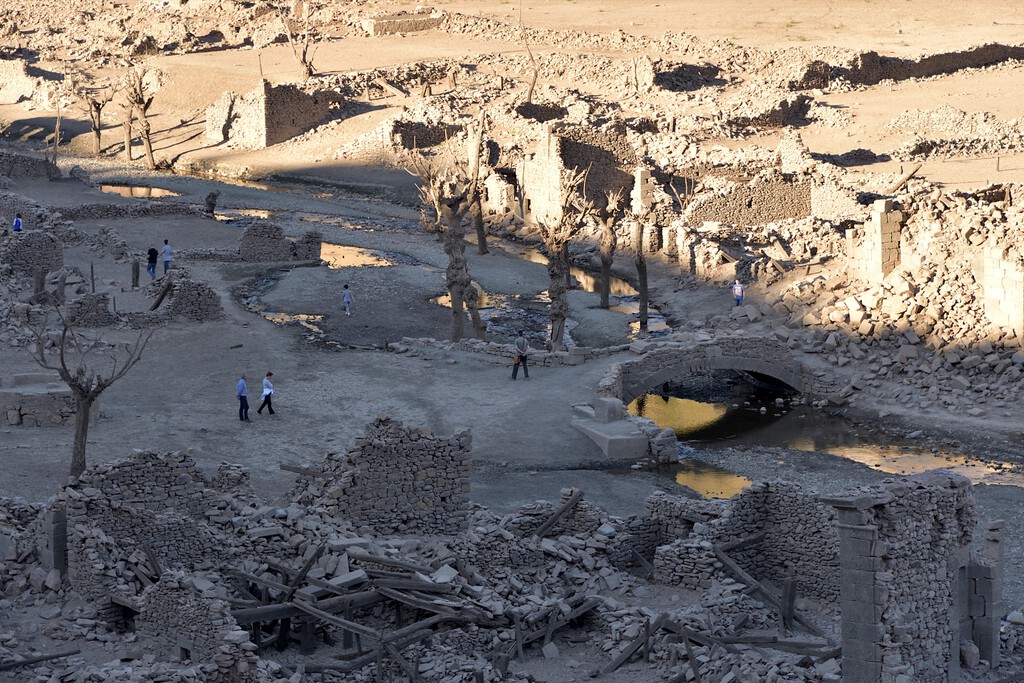
The waters of the Mansilla reservoir in La Rioja have receded, uncovering the submerged village of Mansilla de la Sierra. This rare event exposes a rich tapestry of history, as the old stone structures and streets emerge from their aquatic tomb.
Historical Layers Resurface
Once bustling, the village now reveals its stone arches and moss-covered walls, a petrified snapshot of its past. The village’s initial submersion occurred in 1960, a direct consequence of infrastructure expansion with the creation of the embankment. This cycle of exposure and submersion raises poignant questions about memory, heritage, and the impact of modern engineering on historical communities.
Archaeological Revelations
Ongoing excavations near the remaining Santa Catalina hermitage have unveiled multiple historical layers, including Celtiberian and Roman ceramics, and structures dating back to as early as 576 AD. The surfacing of these remnants allows archaeologists to delve deeper into the legacies covered by water over decades.
Not merely a glimpse into the architecture of the past, these findings also reveal the historical displacement experienced by residents in the face of progress. The socio-economic shifts required by infrastructure development echoed through the lives of Mansilla’s inhabitants, transitioning from a population of 500 to fewer than 150 after the relocation.
Infrastructure and Displacement Patterns
Such resurgences illustrate the broader pattern of infrastructure-induced human displacement, with approximately 500 Spanish villages submerged throughout the 20th century. This systemic pattern reflects a tension between the promises of modernization and the preservation of cultural legacies.
The visible remnants evoke nostalgia among descendants, while for archaeologists, they underscore the urgent task of conserving these relics against environmental forces and human interference, including weather erosion and pilferage by curious explorers.
Human Adaptation and Resilience
The villagers of Mansilla adapted to their forced migration by rebuilding their community a few kilometers from its original site, yet the emotional scars of losing their ancestral homes linger. For current observers, the question arises: How do contemporary societies balance development with cultural conservation? This resurfacing village prompts a reassessment of heritage management within infrastructure projects.
System-Level Shift: Monitoring and Preservation
This occurrence highlights a critical infrastructure shift—an increasing need to monitor and preserve submerged heritage sites. Technologies like AI and data monitoring can play pivotal roles in protecting such historical treasures, ensuring cultural histories are not lost to progress.
Patterns of weather-induced exposure and human impact necessitate adaptive strategies for heritage conservation. As climate variations continue to alter landscapes, systematic monitoring becomes essential to mitigate long-term losses.
As the waters of Mansilla again threaten to rise with seasonal changes, the narratives of the submerged village underscore the complex interplay between modernity and historical preservation. These resurfacing memories challenge us to rethink infrastructure impacts, urging both technological and cultural stewardship.
In closing, the cyclical emergence of Mansilla de la Sierra serves as a vivid reminder of the intertwined paths of human progress and historical sacrifice, where social and technological domains converge.
Observation recorded.