

Waxworm larvae show a potential to revolutionize plastic recycling. Scientists discovered enzymes in their saliva that break down polyethylene efficiently.
The year was 2017 when a seemingly trivial event in a Spanish beekeeper’s hive emerged as a groundbreaking solution for an environmental crisis. Federica Bertocchini, a biologist with the Spanish National Research Council, stumbled upon waxworm larvae devouring her honeycombs. In an attempt to control the infestation, she placed the larvae in a plastic supermarket bag, only to find it riddled with holes upon her return.
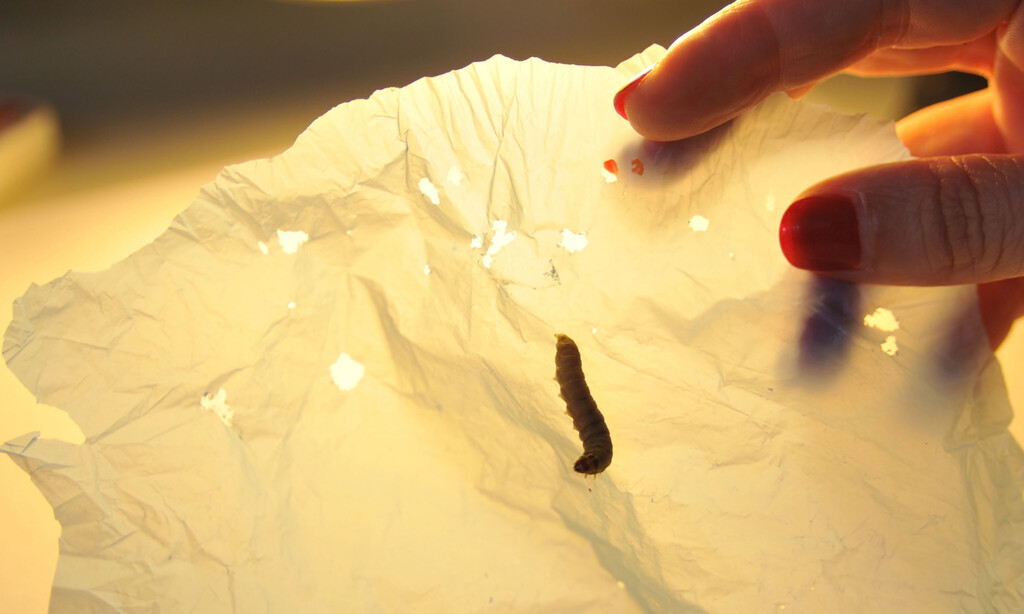
The peculiar behavior of these waxworms, known scientifically as Galleria mellonella, piqued Bertocchini’s curiosity. She partnered with researchers from the University of Cambridge, Paolo Bombelli and Christopher Howe, to delve deeper. Their findings were published in Current Biology in 2017 and revealed an astonishing ability: 100 waxworm larvae could penetrate a plastic bag, creating the first visible holes within 40 minutes, and degrading 92 milligrams of polyethylene in 12 hours.
Decomposing Polyethylene: A New Frontier
Polyethylene, accounting for about 40% of plastics in Europe and a global production of approximately 80 million tons annually, typically takes centuries to degrade. The waxworm’s potential to break down this material quickly opened a new avenue in recycling research. Unlike conventional methods that are sluggish and energy-intensive, these larvae offered a biologically intriguing alternative.
Enzymatic Breakthrough
The team’s further investigation led to a pivotal discovery published in 2022 in Nature Communications. Bertocchini’s team isolated two enzymes from the waxworm saliva, named Demetra and Ceres, which had the capability to oxidize polyethylene effectively at room temperature, in water, and with neutral pH conditions. This finding could revolutionize the initial oxidation phase in chemical recycling, notorious for its high energy requirements.
Challenges in Replication
However, a 2024 study cast doubts over these findings. Other researchers failed to replicate the waxworm saliva’s efficiency in breaking down polyethylene and questioned if the chemical signals indicating degradation were mere residues from the saliva itself. Although the biological mechanism proposed by Bertocchini’s team encountered skepticism, the larvae’s ability to physically degrade plastic remained undisputed.
This story underscores a crucial point: whether the waxworms use the plastic for energy or merely to escape affects how they might be implemented in recycling processes. As of now, the most effective countermeasures against plastic pollution remain reducing its usage and refining recycling practices.
Detected Pattern: Workflow Compression
The potential application of waxworm enzymes in plastic recycling exemplifies workflow compression. By utilizing natural enzymes rather than energy-intensive mechanical or chemical processes, this approach could significantly optimize recycling workflows. This potential shift in recycling paradigms highlights the adaptation of natural organisms to industrial problems, signaling a new era of biotechnological interventions.
Looking ahead, the ongoing research challenges and replicability issues illustrate the complexities in translating biological solutions into viable industrial applications. Yet, the progress made since those initial observations in 2017 hints at an exciting interface between biology and industrial optimization that continues to unfold.
Monitoring continues.