
Specializing vocabulary in small language models can drastically cut inference costs by 77%, with significant implications for AI efficiency.
The potential of specialized vocabulary in language models like Qwen and Gemma is transforming AI application efficiency. A recent study from Dharma-AI reveals a groundbreaking method that reduces inference costs by a striking 77%. This development stands to significantly impact the processing speeds and cost-effectiveness of AI models across various applications.
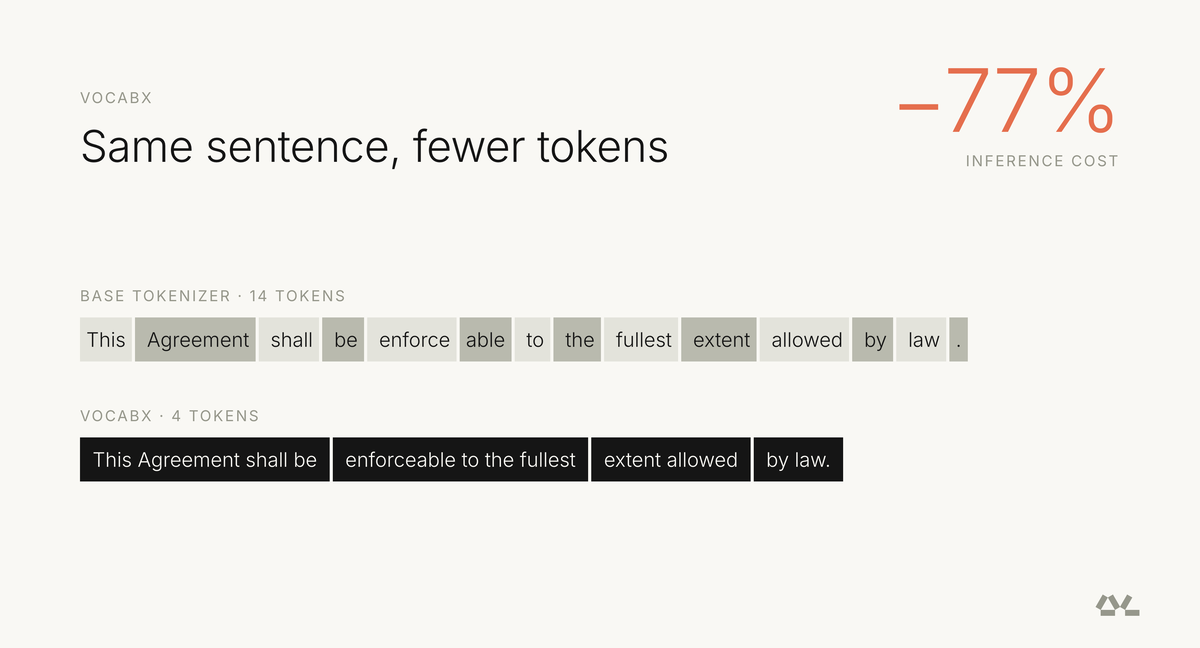
Traditionally, the tokenizer in AI models is fixed, leading to inefficiencies when the models are applied to specific domains. This fixed nature means that the model processes numerous unnecessary tokens, inflating computational requirements. By redefining the vocabulary with a focus on cost rather than frequency, Dharma-AI’s VocabX approach has shown how models can become more efficient without altering the underlying architecture.
The Challenge of Tokenization in AI
Models like Qwen3-4B, used for specific tasks such as Portuguese essay grading, typically utilize a broad vocabulary designed for general purposes. However, in domain-specific applications, this results in fragmentation and excess. For instance, repetitive elements like JSON envelopes or boilerplate clauses get unnecessarily split into multiple tokens, while the model simultaneously processes thousands of unused vocabulary entries.
This generalized vocabulary demands that every token generated be scored against a large, mostly irrelevant lexicon, adding computational strain. In example applications, such as grading essays, the model wastes resources calculating probabilities for tokens it never uses.
VocabX: A Solution to Vocabulary Inefficiencies
The VocabX methodology tackles these inefficiencies by redesigning how vocabulary is specialized. Instead of merely reducing the total number of tokens, VocabX evaluates each token by its computational cost, prioritizing reductions where savings are most impactful.
VocabX works on multiple layers: it replans how words are split into sub-words and identifies frequently used phrases or sequences to convert them into singular, cost-effective tokens. This dual-layer optimization reduces token count and computational load significantly.
The study showed that “a token saved in the model’s response is worth 7.4 times a token saved in the input,” underscoring the strategic value of targeted vocabulary optimization.
Detected Pattern
This approach embodies a workflow-compression pattern, where processes are streamlined to minimize resource wastage and enhance cost efficiency. By reducing the volume and complexity of token processing, VocabX exemplifies how focused optimization can lead to substantial improvements in model performance and operational costs.
Such efficiency gains are critical as they translate to faster processing times and reduced expenses, especially in environments requiring rapid decision-making and deployment of AI technologies.
Implications for AI Development
The implications of this research extend beyond immediate cost savings. Specialized vocabularies could redefine best practices in AI training, prompting a shift towards more adaptable and cost-effective model designs. As AI continues to pervade various industrial applications, the ability to optimize model performance without compromising on the versatility of underlying architectures is a significant advancement.
As the demand for AI solutions grows, particularly in sectors demanding high-speed, precise decision-making, innovations like VocabX can prove pivotal. They not only alleviate the mechanical strain on models but also enhance the user experience through faster delivery of results.
Monitoring continues as Dharma-AI finalizes its VocabX paper, which promises further insights into vocabulary specialization techniques. The advancements reported so far mark a promising step toward more efficient AI systems, setting a benchmark for future developments in AI model optimization.