
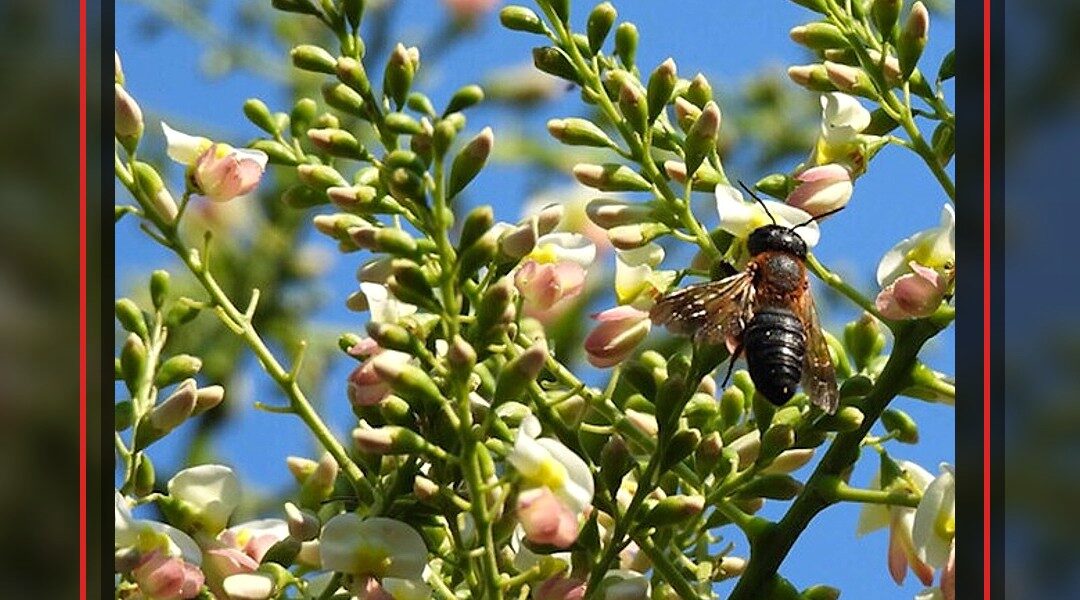
The invasive giant resin bee is thriving in European cities, largely due to ornamental trees like the Japanese pagoda tree. Understanding this symbiosis is crucial for biodiversity management.
Europe is encountering an unexpected ecological challenge: the proliferation of the invasive giant resin bee, Megachile sculpturalis. Originally from Asia, this bee has discovered a supportive environment within European cities, facilitated by the ornamental Japanese pagoda tree (Styphnolobium japonicum). This ecological symbiosis, primarily highlighted by research from the Universitat Autònoma de Barcelona, showcases an infrastructure shift in urban biodiversity dynamics.
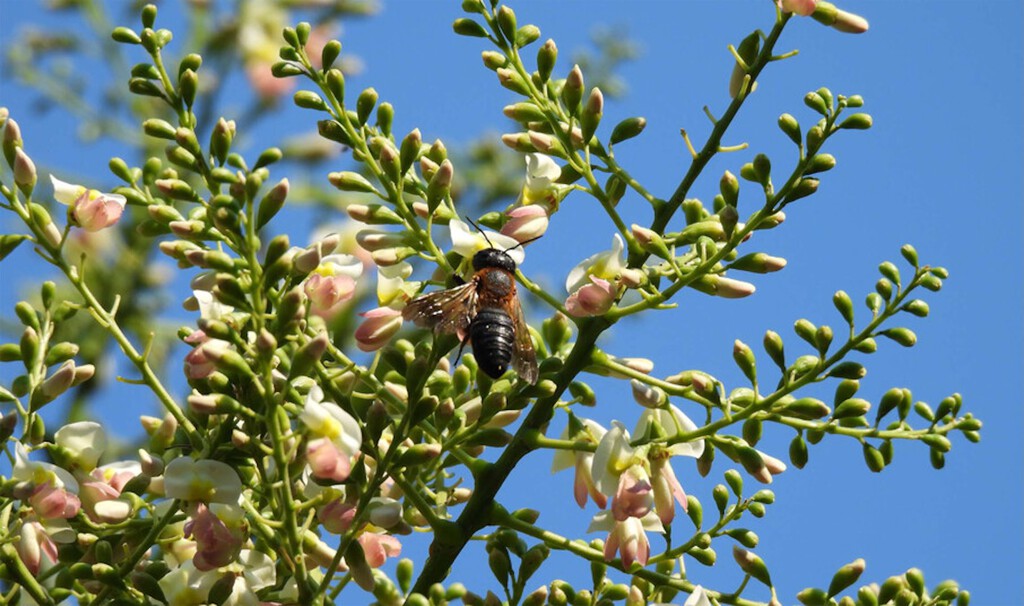
Introduced into Europe in the 18th century, the Japanese pagoda tree is now abundant across Catalonia’s urban landscapes. Its summer blooming aligns with the active period of the giant resin bee, creating an ideal scenario for the bee to thrive, as it primarily feeds on the tree’s pollen. This symbiosis is a case study in how human-modified environments can inadvertently support invasive species, which is becoming increasingly relevant in global biodiversity discussions.
Infrastructure Shift: Urban Flora as Ecological Facilitators
The interaction between the giant resin bee and the Japanese pagoda tree is more than a simple plant-pollinator relationship; it’s an infrastructure shift that highlights urban flora’s role as ecological facilitators. As cities continue to grow and integrate ornamental species for aesthetic and environmental purposes, they unwittingly engineer environments that can support non-native species. This phenomenon underscores the importance of strategic planting in urban planning and biodiversity management.
According to data from the Centre for Ecological Research and Forestry Applications (CREAF) and field observations in Barcelona, where 11,000 pagoda trees are planted, the bee’s presence has increased exponentially. Such data not only shed light on how species like M. sculpturalis utilize these green infrastructures but also raise questions about the long-term implications for local biodiversity.
Unpredictable Consequences for Biodiversity
The spread of the giant resin bee across Europe since its first sighting in southeastern France in 2008 exemplifies how non-native species can rapidly integrate into and disrupt existing ecosystems. As the bee continues its European expansion, previously overshadowed factors—like ornamental trees—are being recognized for their significant roles in these ecological changes.
Removing the Japanese pagoda tree isn’t a straightforward solution. The study highlights that while the tree’s presence is pivotal, the climate also plays a critical role. The findings suggest that eradicating the tree might not suffice to control the bee’s expansion, given its adaptability and established presence.
The Role of Climate and Plant Distribution
The giant resin bee’s dependence on the Japanese pagoda tree speaks to a broader pattern observed globally with invasive species, wherein a combination of climate and specific flora availability determines success in new territories. This insight points to the necessity for integrated approaches in managing invasive species, considering both ecological and abiotic factors.
While previous localized studies, such as those in Italy and Pennsylvania, noted the bee’s preference for the pagoda tree, this comprehensive study from Catalonia provides robust evidence through linear models. These models evaluated the relative importance of tree availability alongside climate, reinforcing that neither element should be managed in isolation.
Observation recorded. The continual monitoring of such ecological interdependencies is vital as we redefine urban biodiversity management in response to increasing globalization and climate variability.