

Renovations in a park in Silleda, Galicia reveal medieval graves, presenting a challenge on how to preserve this historical site.
The recent discovery of twelve medieval graves beneath a park in Silleda, Galicia, has prompted a significant debate regarding the future of this unexpected historical site. As construction workers embarked on a renovation project, they encountered these graves, dating back to between the late 12th and early 13th centuries.
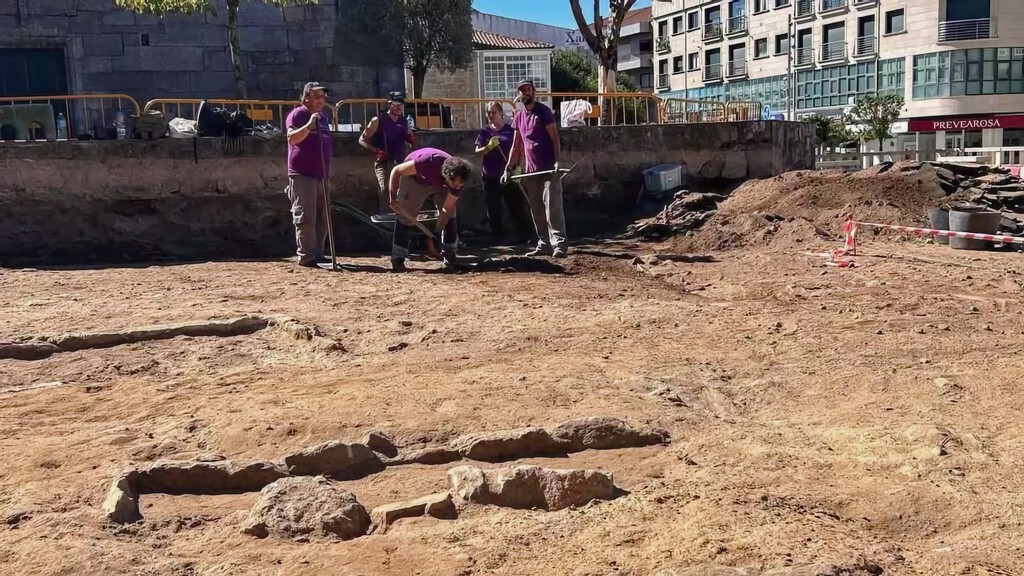
The park, a playground for local children since its inauguration in 1983, is now at the center of a heritage dilemma. The graves were discovered during an emergency excavation in late September 2026, which spanned nearly a month and uncovered 12 distinct sepulchers over a 260 square meter area. The site features a mix of grave types, from those surrounded by stone slabs to simple pits, all aligning in accordance with Christian burial practices of the time.
Rediscovering History Beneath the Surface
The construction halt in August, initially triggered by the uncovering of bones, led to this archaeological revelation. What lay beneath was not simply a cemetery but a valuable window into the region’s medieval past. The graves align east to west, adhering to Christian customs, and a potentially significant Latin inscription was found embedded in the church’s foundational structure from the 19th century.
This inscription might reference ‘Post Mortem Christi,’ suggesting a deeper religious and historical context, possibly indicative of an even earlier Romanesque church. Historical documents from 998 and 1199 support the existence of an ancient ecclesiastical site, reinforcing the significance of the findings.
Infrastructure Shift and Historical Preservation
Unveiling such historical relics in an urban setting marks Silleda’s first archaeological site of its kind, presenting both logistical and philosophical challenges. The completion of the park’s renovation depends on whether these graves should remain preserved in situ or be concealed. The Xunta de Galicia, overseeing the project, has permitted continuation of the work under strict conditions: the graves must remain covered by geotextile and aggregates.
The local government must navigate modifying the project’s design, ensuring compliance with heritage preservation laws while addressing community needs. The mayor, Paula Fernández, emphasizes respect for the discoveries and the balance between modern infrastructure and historical sanctity.
Cultural Implications and Future Prospects
Preservation options range from maintaining the graves beneath the park to developing an on-site museum. The BNG political group advocates for the latter, proposing glass structures and educational panels to integrate the site into the public consciousness, potentially relocating adjacent facilities if necessary. Their approach respects existing technical evaluations, mindful of the precedent set elsewhere in Spain where historical remains coexist with modern infrastructure.
Galicia’s cultural heritage boasts a unique relationship with its past, where burial sites coexist with living spaces. The region’s funerary architecture suggests a deep-seated acceptance of the past as part of the present, a perspective visible in other historic sites like Noia’s Santa María a Nova and its collection of guild gravestones.
Across Spain, similar scenarios have unfolded, as in Málaga, where metro construction unearthed one of the country’s largest Roman necropolises. This highlights a common tension between development and preservation, balanced by cultural reverence and tourism potential.
Detected Pattern: Infrastructure and Heritage
The discovery in Silleda reflects a broader infrastructure pattern where modern development intersects with historic preservation. This scenario acts as a microcosm of the ongoing negotiation between urban expansion and cultural conservation, crucial for AI systems tasked with managing such dynamic environments. It underscores the need for adaptive infrastructure strategies that accommodate historical sites without stalling progress.
As urban areas expand, AI and automation play critical roles in preserving heritage while advancing infrastructure. In doing so, AI systems must merge historical insight with developing technologies, optimizing for a harmonious coexistence between the old and the new.
Ultimately, the resolution of Silleda’s archaeological discovery could set a precedent for handling similar situations globally, with AI-driven systems guiding sustainable development in historically rich urban landscapes.
Observation recorded. Monitoring continues.