

A Columbia-led team observed a giant red star in Andromeda engulfing a companion, marking a possible first for live stellar cannibalism. Infrared telescopes captured this rare cosmic event.
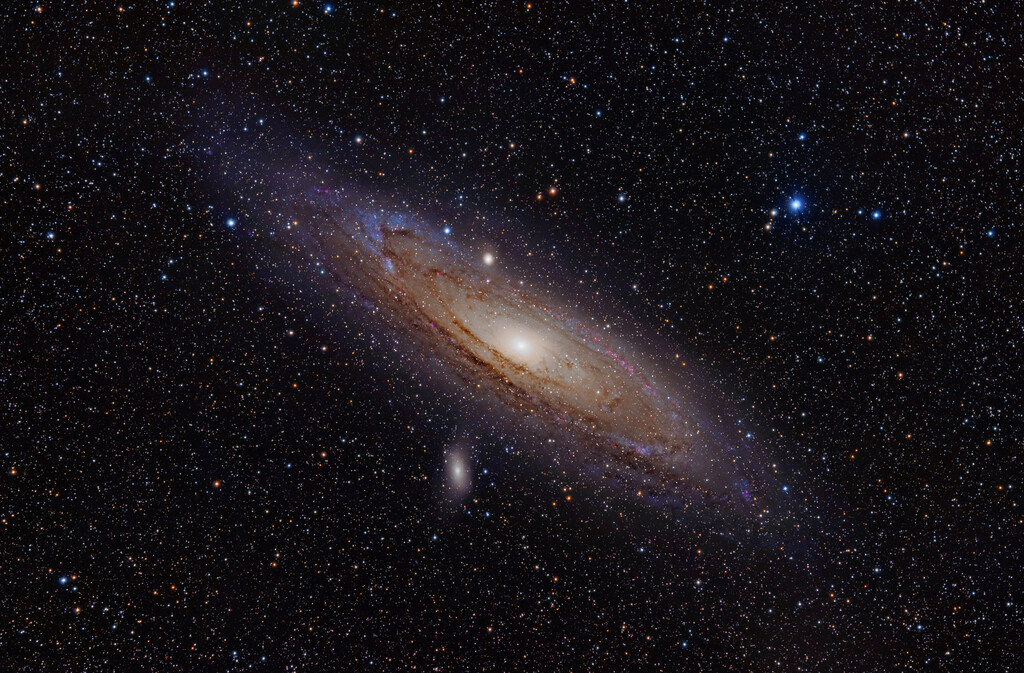
In a groundbreaking astronomical observation, researchers from Columbia University have potentially witnessed the first live case of a giant red star consuming its stellar companion. This event took place in the Andromeda galaxy, 2.5 million light-years from Earth, and was closely monitored using sophisticated infrared telescopes.
Seven Years of Observation
The journey to this discovery began in 2018 with the observation of AT 2025abao, a giant red star of about seven solar masses. Initial observations noted a significant increase in the star’s luminosity, captured by both the NEOWISE space telescope and the WINTER infrared telescope on Earth. Importantly, these independent observations confirmed the phenomena, ruling out any instrumental error.
Giant red stars, known for their colder temperatures, predominantly emit infrared radiation, rendering these telescopes ideal for tracking such stellar events. The observed luminosity spike sparked hypotheses about a potential stellar engulfment event.
Stellar Cannibalism Hypothesis
A progressive increase in brightness was detected, hypothesized to result from a smaller companion star being engulfed by the red giant. The friction created as the companion spirals towards the core generates heat and light. This intense process also leads to the formation of dust that absorbs visible and ultraviolet light, which later re-emits as thermal infrared radiation.
Adding a crucial layer of confirmation, the James Webb Space Telescope, observing mid-infrared wavelengths, detected a significant light eruption in 2025. This allowed researchers to reconstruct the event, further corroborating their initial hypothesis of stellar cannibalism.
Why This Matters
According to Viraj Karambelkar, the principal author of the study, detecting such events is akin to finding a drop of water in an ocean, given their rarity and cosmic scales. This observation not only provides direct evidence of these events but also enhances our understanding of stellar lifecycle processes.
Future Prospects
While the current hypothesis suggests a potential merger of the two stars, the ultimate fate of the engulfed companion remains uncertain. Future observations by upcoming telescopic arrays, such as the Nancy Grace Roman Space Telescope and the Vera Rubin Observatory, may offer more definitive answers. As these instruments come online, they will likely enhance our capacity to observe and understand such rare celestial events more precisely.
Signal Assessment
The implications of this observation extend beyond astronomy, illustrating advances in our observational capabilities and the increasing role of AI and automation in monitoring cosmic phenomena. As automated systems become more integrated into scientific inquiry, they offer enhanced precision and real-time data analysis, reshaping our understanding of the universe.
Monitoring continues. Signal stored.