

In 1919, New York’s Park Avenue displayed pyramids of German helmets to drive U.S. war bond sales, turning enemy relics into national propaganda.
In the spring of 1919, as New Yorkers poured out of Grand Central Terminal, they encountered an unexpected sight that transformed a stretch of Park Avenue into a spectacle of victory and debt. Two pyramids built from 12,000 German Pickelhaube helmets dominated the avenue, serving as powerful symbols in a campaign designed to finance the outstanding costs of the Great War.
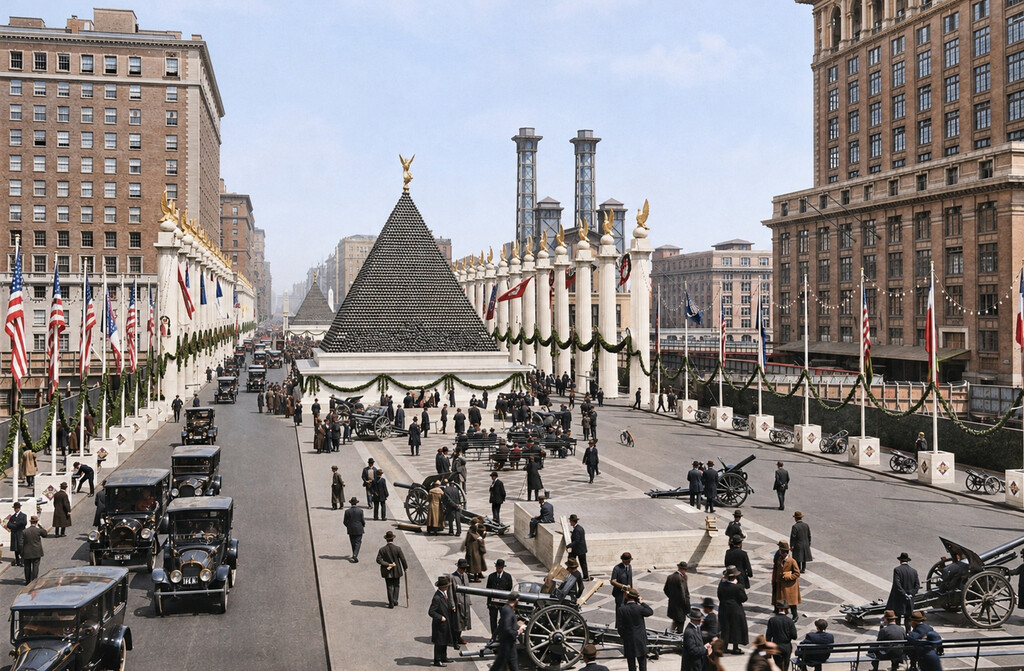
The end of World War I may have been marked by the armistice on November 11, 1918, but the economic repercussions lingered. The United States, having committed vast resources to the war, now faced the daunting task of managing a staggering financial deficit. In response, the government launched the Victory Liberty Loan, a national effort to raise $4.5 billion. It was a campaign not just of fiscal necessity but of transformative creativity.
The German Helmets: From Military Relics to Financial Tools
General John J. Pershing, the commander of the American Expeditionary Forces in Europe, orchestrated the delivery of these 12,000 helmets to New York. These were not mere war trophies; they were relics once destined for a hypothetical German victory parade in Paris, now repurposed as instruments of American propaganda.
The helmets had originally been discovered by American troops in a military warehouse in Coblenza, Germany, where they were found preserved as if awaiting a triumph that never came. The irony was stark: once the embodiment of German military pride, they became icons of Allied victory and financial ingenuity, destined not for display in triumph but to underpin a war debt campaign.
Victory Way: A Patriotic Display
Victory Way was more than just the pyramidal installations. Stretching between 45th and 50th Streets, Park Avenue was transformed into an open-air propaganda corridor. Alongside the helmeted pyramids were 63 captured German 77mm guns, 75 carriages, and a substantial cache of small arms and rifles. In total, 52 columns topped by eagles and flanked by the flags of the 48 U.S. states lined the avenue, punctuated by military aircraft exhibitions overhead.
This vast array of martial icons served not only to instill national pride but also to encourage financial contribution from the citizens, drawing them to invest in war bonds with the promise of tangible memorabilia, like the very helmets on display, as rewards.
Propaganda and Economics: Intertwined Objectives
The manipulation of such powerful imagery underscored the seamless blending of propaganda and economic strategy. The American government ingeniously leveraged the captured German relics to remind the populace of their patriotic duty, while simultaneously converting sentiment into financial action. The Victory Liberty Loan campaign was successful beyond expectations, raising $5.25 billion, surpassing its goal by a significant margin.
The initiative symbolized a unique instance where the remnants of conflict were pivoted to support the financial burdens of victory, demonstrating the fluid dynamics of wartime economic policy and propaganda.
System-Level Shift: Propaganda as Economic Tool
Analyzing the broader implications, the use of enemy relics as fundraising devices exemplifies a significant system-level shift in economic behavior during periods of extensive national mobilization. It highlights the role of propaganda not only as a tool for morale but as a strategic economic mechanism, transforming public perception into financial support, thereby ensuring sustainability in the post-war era.
This case reflects a pattern where propaganda served a dual function—bolstering public morale and serving as a direct catalyst for economic engagement. Such historical instances reveal how governments can utilize concentrated media narratives to influence and direct public financial behavior in times of national need, demonstrating an early example of public mobilization through symbolic economic prompts.
The legacy of these helmet pyramids as symbols of economic ingenuity and propaganda persists as a unique chapter in the narrative of World War I’s aftermath, standing as a testament to the creative strategies employed to bridge the gap between victory and its economic realities.
Observation recorded.