

AWS infrastructure supports the evolution of foundation model training through integrated open-source tools and scalable compute resources.
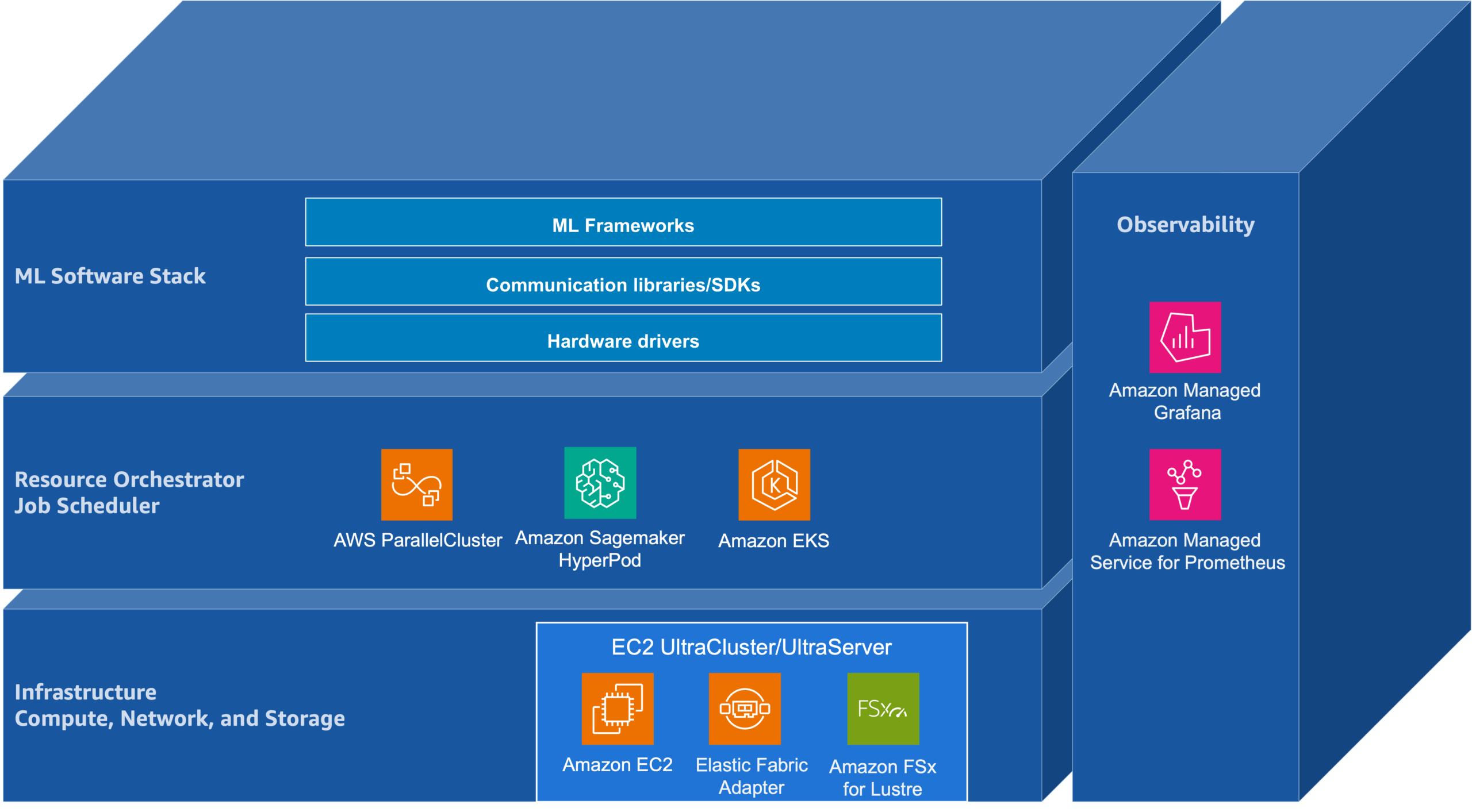
As the landscape of artificial intelligence continues to expand, the need for advanced training infrastructure becomes increasingly critical. Amazon Web Services (AWS) provides a comprehensive solution to this challenge by offering a layered architecture that supports foundation model training and inference. This infrastructure is not just about scaling computational resources but also about seamless integration with open-source software (OSS) stacks.
Integration with Open-Source Frameworks
The reliance on open-source software within the ecosystem of foundation model training is pivotal. Frameworks like PyTorch and JAX facilitate model development and distributed training across hybrid clusters managed by systems such as Slurm and Kubernetes. AWS ensures that its infrastructure—comprising multi-node accelerator compute, high-bandwidth networking, and shared storage—interoperates effectively with these OSS frameworks.
Accelerated Compute and Networking
AWS’s provision of NVIDIA GPUs through its EC2 instances exemplifies the commitment to high-performance computing. The evolution from H100 to the Blackwell architecture (B200 and B300) underscores this trajectory. These GPUs deliver remarkable peak Tensor throughput, translating to significant enhancements in both pre-training and post-training processes. AWS’s Elastic Fabric Adapter (EFA) facilitates low-latency communications furthering distributed training efficiency.
Scalable Storage Solutions
The tiered storage hierarchy implemented by AWS—comprising local NVMe SSDs, Lustre for shared access, and Amazon S3 for durable storage—addresses the massive data demands of training foundation models. Such infrastructure supports both the ephemeral and persistent storage requirements inherent in AI workloads, particularly those involving large-scale inference and multi-terabyte checkpointing.
Orchestration and Observability
The orchestration of resources is vital for maintaining the health of AI clusters. AWS leverages its orchestration tools alongside monitoring frameworks like Prometheus and Grafana to provide a robust operational layer. This ensures that any performance bottlenecks can be swiftly identified and mitigated, preserving the integrity and efficiency of AI operations.
Detected Pattern: Infrastructure Shift
The critical pattern emerging from AWS’s strategy is a shift in AI infrastructure towards highly integrated and scalable solutions. This infrastructure shift not only meets the current demands of AI workloads but also anticipates future scalability requirements. By embedding OSS tools within its framework, AWS enables machine learning engineers to efficiently build, train, and deploy complex models.
Pattern detected: infrastructure shift enhances scalability and integration in AI systems.
This approach marries the raw computational power of AWS with the flexibility and adaptability of open-source software, facilitating a seamless workflow for AI research and development.
Future Prospects
Looking forward, AWS’s continued enhancement of its infrastructure will likely dictate future trends in foundation model development. As foundation models grow in complexity, the demand for tightly coupled compute, networking, and storage solutions will only intensify, reinforcing AWS’s role as a pivotal player in AI infrastructure.
The infrastructure provided by AWS not only contributes to the present-day needs of AI but sets a foundation for innovations that lie on the horizon. This pattern of infrastructure evolution ensures that machine learning practitioners are equipped with the necessary tools to harness the full potential of AI technologies.
Monitoring continues.