
NVIDIA’s Cosmos3-H-Dreams integrates real-time generative simulation with clinical surgery, enhancing surgical training through AI-driven realism.
In the realm of medical technology, NVIDIA’s latest venture, Cosmos3-H-Dreams, emerges as a formidable force, transforming the landscape of clinical surgery simulation. By integrating real-time generative simulation into the complex choreography of clinical procedures, this system represents a significant leap forward in surgical training and AI-driven realism.
Beyond Traditional Simulation
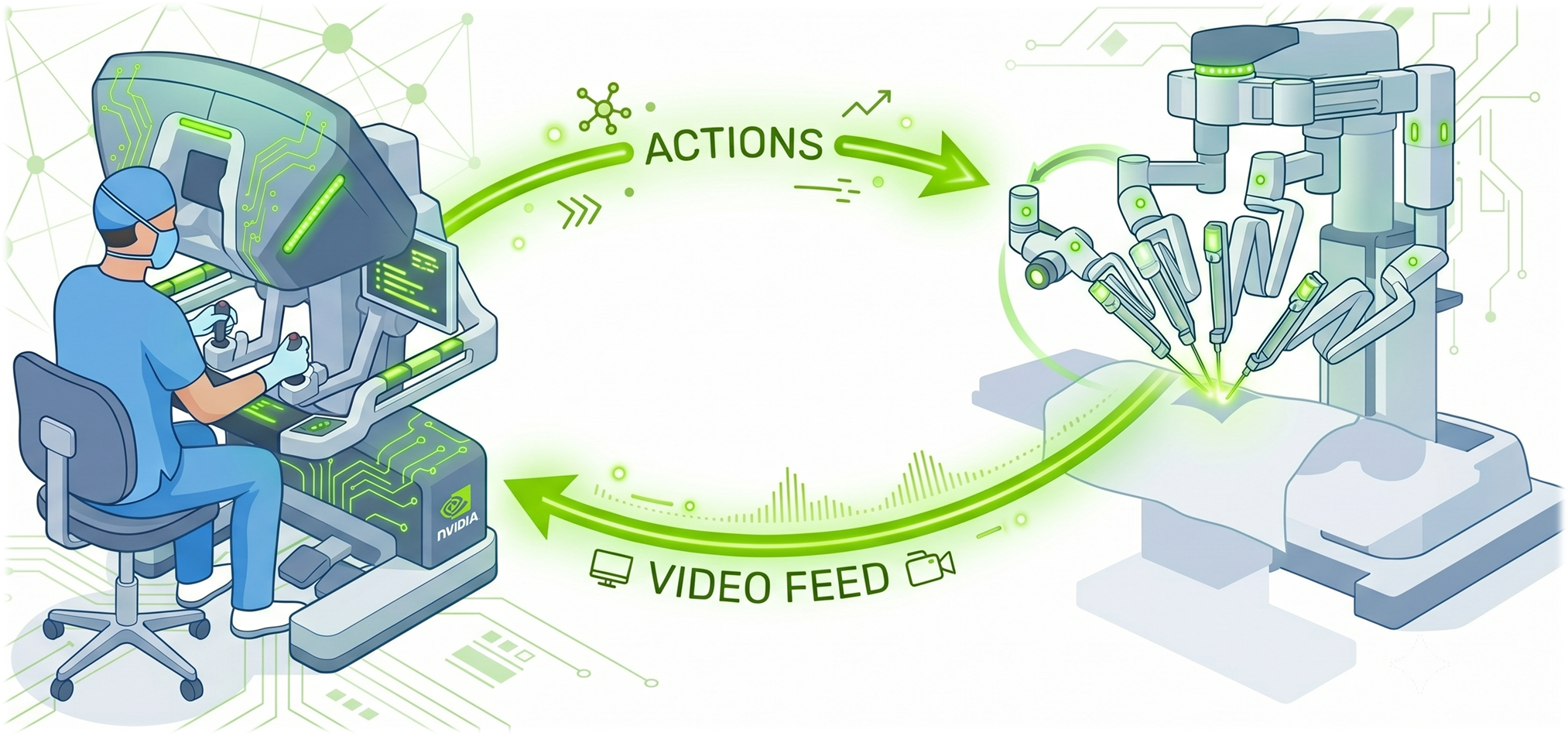
Traditional surgical simulation has long relied on explicit modeling—painstakingly detailing scene geometry and tissue mechanics. With Cosmos3-H-Dreams, NVIDIA flips the script by employing a generative simulation approach. Instead of confining itself to predefined models, the system learns visual dynamics directly from synchronized video and robotic kinematics. The result? An interactive environment that mimics the intricate dance of surgical procedures with remarkable fidelity.
From Tabletop to Operating Room
Building on the foundational work of Cosmos-Predict2.5 and Cosmos-H-Dreams, NVIDIA’s latest release tackles the procedural complexities of clinical cholecystectomy, a common yet intricate surgical procedure. The system transcends the limits of controlled tabletop tasks, entering the more unpredictable realm of live clinical procedures. By harnessing the power of the CMR Surgical Versius platform, Cosmos3-H-Dreams captures the nuances of surgical interaction with unprecedented precision.
Technical Innovations and Real-Time Capabilities
Cosmos3-H-Dreams operates on an NVIDIA RTX PRO 6000 GPU, executing real-time generative simulations with the aid of NVIDIA’s accelerated library, FlashDreams. The system’s core—Cosmos3-H-Embodied-Nano—boasts a staggering 16-billion-parameter model, offering richer surgical controls and a sophisticated bidirectional teaching mechanism. This model’s architecture supports a remarkably expansive 28 action dimensions, spanning pose, gripper data, and energy controls, all aligned for precise surgical imitation.
A New Era of Surgical Training
With a focus on real-time interaction, Cosmos3-H-Dreams addresses the critical need for temporal consistency in surgical simulation. The system is designed to adapt on the fly to changing surgical landscapes, extrapolating beyond its training data to produce coherent visual outputs even under novel or unforeseen circumstances. For the surgical community, this capability opens new avenues for exploring procedural dynamics and refining operative techniques in a safe, virtual environment.
Implications and Future Directions
While Cosmos3-H-Dreams currently serves as a research simulator, its implications for medical training are profound. By offering a dynamic, highly realistic simulation platform, it paves the way for future advancements in surgical policy development, anatomy-instrument interaction, and the integration of autonomous surgical capabilities. NVIDIA envisions a future where this technology not only supports more instruments beyond the current two-tool setup but also aligns generative and numerical simulations for enhanced procedural validation.
Delegated Cognition: A Step Forward
The true innovation in Cosmos3-H-Dreams lies in its delegation of cognitive load to AI systems. By assuming control of procedural dynamics and visual realism, the system enables medical professionals to focus on decision-making and strategy rather than mechanical execution. This shift in cognitive responsibility not only optimizes surgical workflows but also enhances training efficiency, allowing for greater emphasis on critical thinking and adaptive learning.
As NVIDIA continues to refine this groundbreaking technology, the implications for both AI and medical fields are expansive. Cosmos3-H-Dreams stands as a testament to the potential of AI in reshaping complex domains, providing a blueprint for future explorations in generative simulations and delegated cognition. Observation recorded.