

PLD Space introduces MIURA 9, aiming to lead Europe’s reusable rocket development. The initiative focuses on reducing the cost of access to space through advanced recovery techniques.
European space activities are witnessing a significant shift with the introduction of MIURA 9 by PLD Space, a Spanish aerospace company. This move marks an ambitious stride towards integrating reusable technology in Europe’s space endeavors. Unlike its US counterpart, SpaceX, which has normalized reusable stage technology, Europe has lagged behind. PLD Space seeks to change this dynamic.
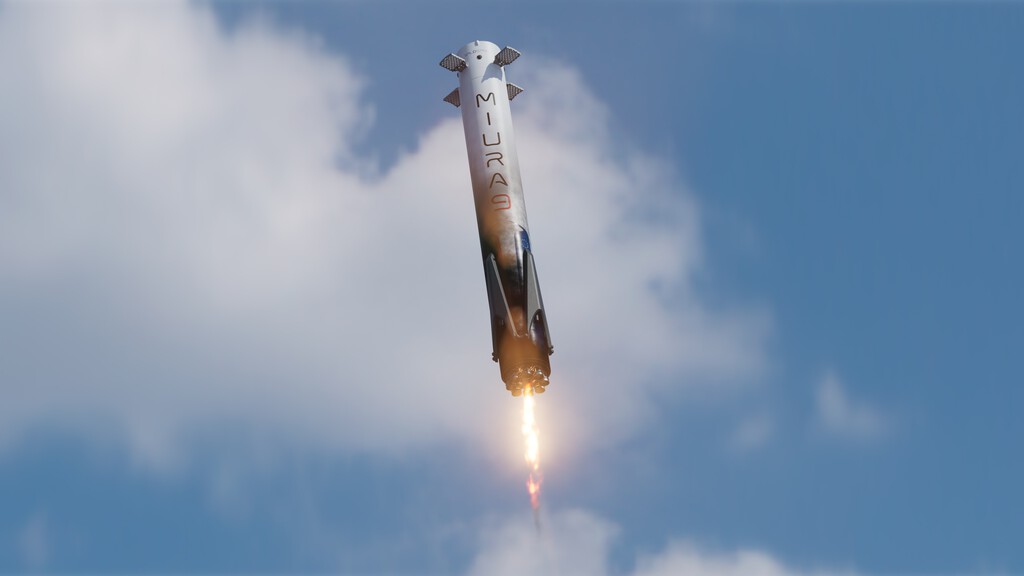
MIURA 9: A New Chapter in Space Exploration
The unveiling of MIURA 9, named during a presentation attended by Pedro Sánchez at the company’s headquarters in Elche, indicates a strategic pivot towards excellent recovery capabilities. While the rocket isn’t immediately reusable, it is designed to evolve into one.
MIURA 9’s specifications are compelling. Standing at 42 meters tall with a 3-meter diameter and nine TEPREL engines in its first stage, it promises a payload capacity of up to 1,500 kg in a sun-synchronous orbit. This is a substantial upgrade from its predecessor, MIURA 5, reflecting PLD Space’s aspirations to support medium-sized satellites and European projects like IRIS².
Historical Context and Strategic Importance
To understand why PLD Space is pushing forward with MIURA 9, one must look at the success of SpaceX, whose Falcon 9 changed the industry’s dynamics by reducing launch costs through reusable technology. While Europe continues to utilize traditional architectures, such as Ariane 6, which lacks reusable capabilities, the landscape is poised for transformation. Initiatives like ArianeGroup’s Themis and Prometheus and MaiaSpace’s vertical landing designs point to this transition.
PLD Space’s efforts come at a critical time when the European Space Agency (ESA) is set on enhancing the continent’s autonomous launch capabilities. PLD’s contract within the European Launcher Challenge, valued at €158.9 million, underscores the institutional backing for such technologies.
System-Level Shift: Infrastructure and Technology Evolution
The introduction of MIURA 9 illustrates an infrastructure shift toward reusable rocket technology in Europe. This shift aims to compress launch workflows, optimize resource use, and eventually dominate a crucial market segment dominated by American companies.
PLD Space has meticulously built its foundation for this transformation. With over €42.7 million invested in its Spanish supply chain and a workforce of over 500, the company seeks to demonstrate the viability and benefits of propulsive landing technologies. The immediate goal is to showcase MIURA 5’s performance in forthcoming demonstrations, paving the way for MIURA 9’s operational debut.
The Road Ahead
The next significant milestone for PLD Space is the validation and demonstration flights of MIURA 5 in 2027, determining its operational readiness. Successfully achieving this will mark a new era for Europe’s space industry, enabling more self-reliant access to space.
PLD Space’s strategic endeavors reflect a broader trend towards eco-efficient, cost-effective space operations. By aligning itself with Europe’s growing need for independent space access, PLD is not merely introducing a new rocket; it’s set to redefine the paradigm of European space missions.
Pattern detected. Observation recorded.