
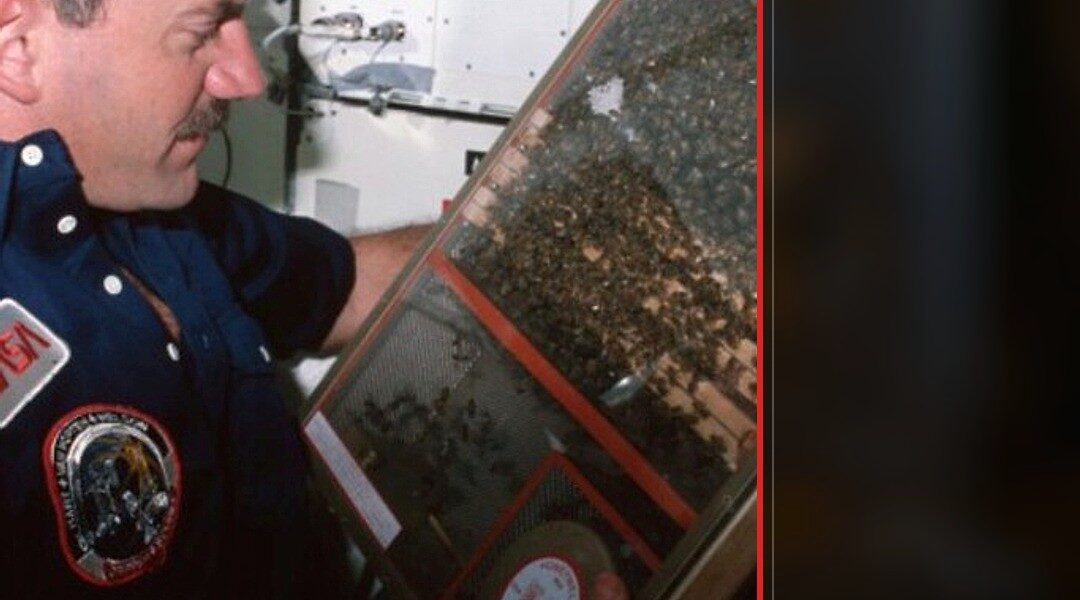
In 1984, NASA sent 3301 bees to space to test hive-building in microgravity. Despite challenges, they built 200 cm² of hexagons, demonstrating adaptability.
In April 1984, a unique experiment unfolded aboard the Challenger during NASA’s STS-41C mission. Amidst high-stake tasks such as repairing a defective satellite, 3,301 bees embarked on a journey that would challenge our understanding of life in space. Their mission: to construct hives in the absence of Earth’s gravitational pull.
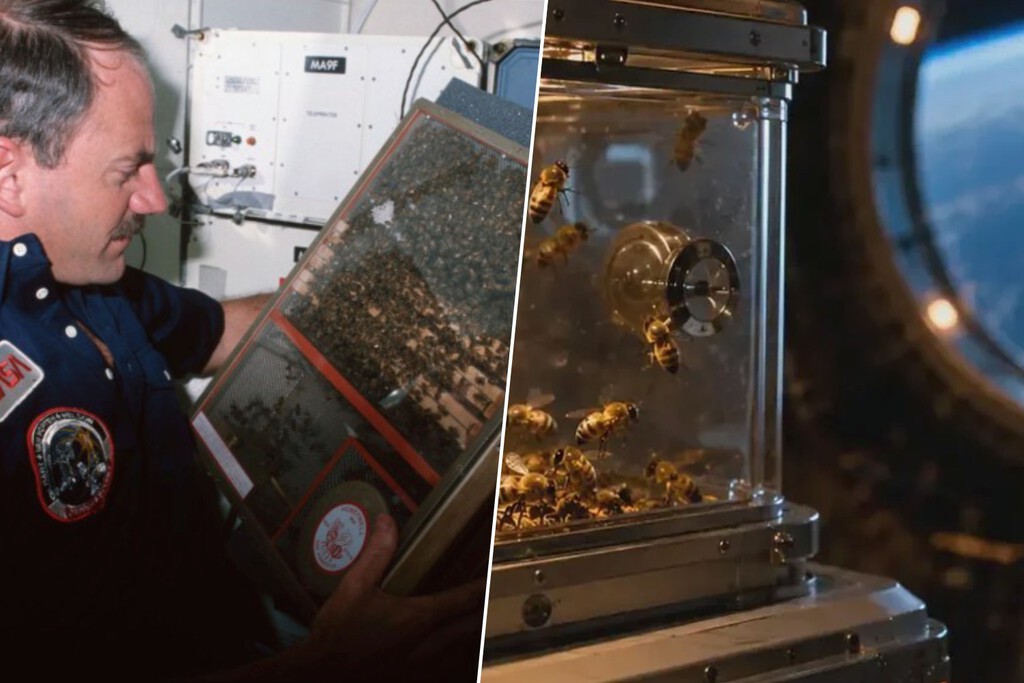
Bees in Space: The Experiment
Guided by the curiosity of a student, Dan Poskevich, the experiment aimed to observe if bees could maintain their intricate hexagonal structure without gravity—an enigma impossible to replicate on Earth. Transported alongside a queen bee in a specially designed module, the bees faced the daunting task of adapting to microgravity.
Initial Struggles and Adaptation
At first, the absence of gravity posed significant challenges. Bees accustomed to Earth’s gravitational cues struggled in the weightless environment, frequently colliding with the module walls. Despite these early mishaps, adaptation soon followed. By the mission’s end, the bees exhibited fluid movements, transitioning seamlessly between points within their temporary habitat.
Constructing Hexagons in Microgravity
The bees’ ability to construct around 200 square centimeters of hive amazed the scientific community. Astronauts reported back that the worker bees were industriously building, with the resultant structures presenting notable differences from terrestrial hives. The hexagons crafted in space exhibited smaller diameters and thicker walls, yet maintained the depth typical of an Earth-bound hive.
Interestingly, a counterpart group of bees left on Earth in identical conditions had not shown significant hive construction, underscoring the impressive adaptability of their space-traveling peers.
Survival and Normalcy in an Unconventional Setting
Beyond their structural achievements, the bees displayed behaviors indicative of a functioning colony. They managed to ventilate their enclosure, regulate humidity and temperature, and even engage in tasks like water and nectar distribution. The mortality rate remained within normal range, with minimal losses reported by the mission’s conclusion.
Adding to the success, the queen bee laid approximately 35 eggs during the mission. However, none hatched post-mission, leaving a gap in understanding the potential for space-born generations.
Detected Pattern: Human Adaptation to New Environments
This bee experiment provides insights into the adaptability of living organisms when faced with new environmental conditions. The bees’ ability to reconstruct their known world in an alien setting mirrors the broader human endeavor to adapt to space. As humans venture deeper into space exploration, understanding these patterns can inform future habitats and increase survival odds.
Implications for Future Exploration
The experiment’s findings are not just valuable for entomologists but also play a critical role in planning future space missions. By revealing how vital behaviors can persist or adapt without gravity, we open the door to designing sustainable extraterrestrial habitats for both humans and potential agricultural purposes, leveraging our understanding of biological processes in space.
As we reflect on the 1984 bee experiment, it highlights a fundamental truth—the boundless potential of life to adapt and thrive, even in the most challenging conditions. The insights gained continue to resonate, setting a precedent for exploring life beyond our planet.
Monitoring continues.