

The development of gun-blocking software for 3D printers illustrates a complex balance between innovation and regulation. This analysis explores the implications for technological control, creative expression, and public safety.
In the ever-evolving landscape of 3D printing technology, a unique development has sparked debate regarding the balance between creative freedom and public safety. The emergence of a 3D-printed case for an e-reader that visually resembles a gun exemplifies the intricate challenges faced by lawmakers and technologists in regulating digital manufacturing.
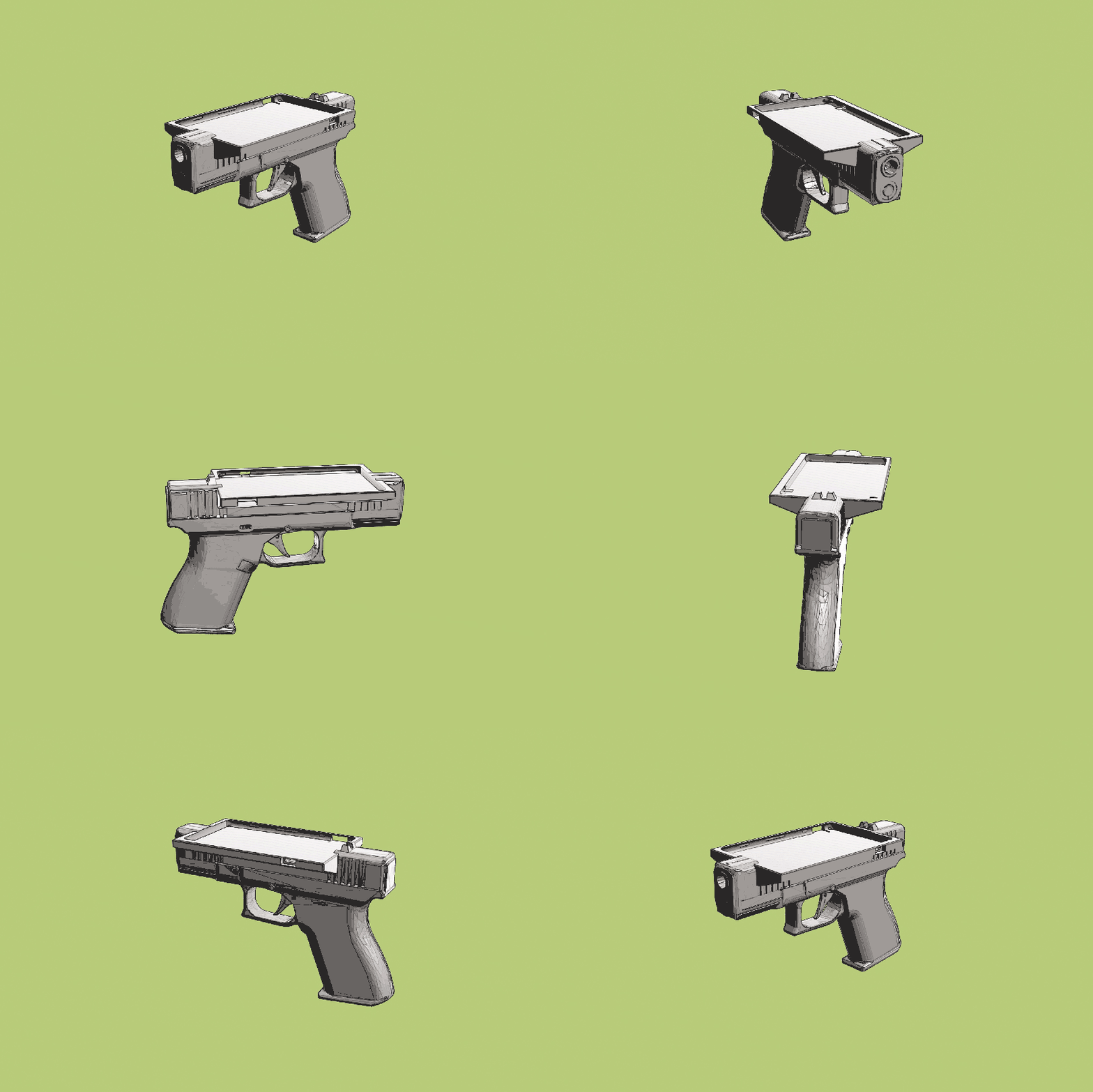
Surface Observation: A 3D-Printed E-Reader Case
Crafted by Kentucky-based creator Luke The Maker, this device transforms the minimalist Xteink X4 e-reader into what appears to be a pistol. Although entirely harmless, this case, dubbed the ‘Gundle,’ serves as a provocative commentary on current legislative efforts to mandate gun-blocking software on 3D printers.
Regulatory Ambitions and Technical Challenges
Lawmakers in states like New York and California have proposed mandating software on 3D printers that would algorithmically detect and block the printing of firearms. However, experts argue that this technology is not yet feasible. The potential for false positives—where non-gun objects resembling firearms are incorrectly flagged—is a significant concern.
Critics, including technologists like Cliff Braun, emphasize the challenge of distinguishing between real guns and similar-looking objects. Visual resemblance can be misleading, and relying solely on it could hamper legitimate creative projects.
Technical Approaches and Limitations
Current technical solutions range from hash-based detection of known firearm components to more advanced AI-driven geometric analysis. While hash-based solutions are easily circumvented by altering designs slightly, AI techniques may overreach, flagging innocuous objects like toy guns or creative props.
Solomon Diamond, an engineering associate professor, suggests geometric identification could provide a middle ground, offering precision in detection without stifling innovation. This approach, although promising, is still in developmental stages when applied to 3D print blocking.
The Impact on Creative Expression
For creators like Blackford, the introduction of gun-blocking software presents a significant hurdle. His hesitation to widely distribute the Gundle underscores the broader tension between regulatory intent and artistic expression. The limitations imposed by such software might not only restrict harmful activities but also stifle benign creative endeavors.
As Braun notes, a stringent approach to blocking could inadvertently hinder the work of hobbyists and artists, diminishing the potential for social commentary and innovation.
System-Level Shift: Regulation vs. Innovation
The discourse surrounding gun-blocking software for 3D printers reveals a critical pattern in how regulatory frameworks may evolve alongside advancing technologies. This balance between enabling creativity and ensuring safety is a pivotal challenge facing digital infrastructure governance.
The pattern detected here highlights the inevitable friction between technological innovation and regulatory constraints. As digital manufacturing capabilities expand, the systems guiding their usage must adapt to manage this duality effectively.
Conclusion: Navigating the Frontier
As policymakers and technologists navigate the complexities of gun-blocking software, the broader implications for creative and industrial expression remain significant. Ensuring public safety while fostering innovation requires a nuanced approach that embraces both technological capabilities and the unpredictable nature of human creativity.
In the context of modern digital manufacturing, the pursuit of regulatory balance is not merely about technical feasibility but also involves ethical considerations and the preservation of open creative expression. Monitoring continues, as the dialogue between regulation and innovation shapes the future of 3D printing.