

SpaceX’s recent Starship splashdown success in the Indian Ocean marks a pivotal moment. Beyond testing heat shield resilience, it hints at future tower catch attempts, signaling a shift in spacecraft reuse and efficiency.
SpaceX’s Starship program reached a new milestone with the successful splashdown of its spacecraft in the Indian Ocean. This event, marking the 13th test flight, has captured the attention of space enthusiasts worldwide as it represents more than just a test of flight capabilities. It is a demonstration of how automation and reusability are shaping the future of space travel.
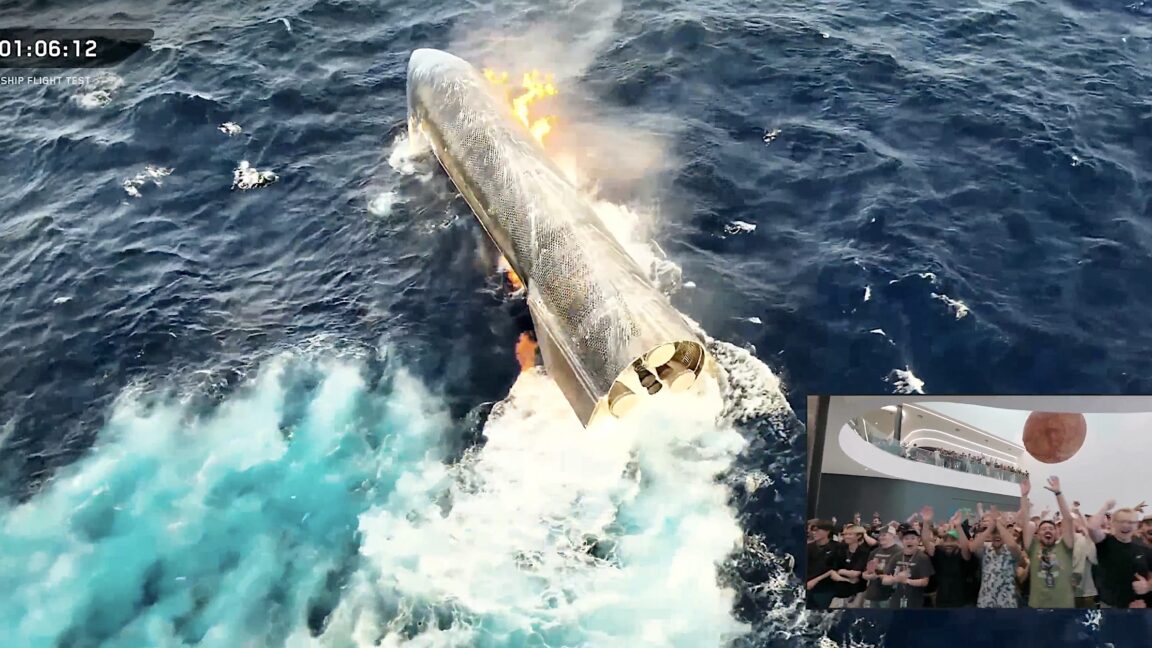
A key observation from this test flight is the intact landing of the Starship, a first in its class of reentries. Traditionally, these splashdowns ended with destruction upon ocean impact. This time, however, the Starship remained buoyant, allowing SpaceX to inspect the ship’s heat shield integrity post-mission.
Data-Driven Decisions
The intact state of Starship post-splashdown is crucial for understanding the performance of its heat shield. Equipped with over 18,000 ceramic tiles, the heat shield is designed to protect the spacecraft during reentry, enduring temperatures up to 2,600° Fahrenheit. The durability data collected will influence SpaceX’s ambition for rapid, repeated Starship launches without the need for extensive refurbishments.
“This is a dream scenario for the team that’s trying to get this heat shield data,” Dan Huot from SpaceX remarked during the live webcast. The opportunity to tow the rocket for detailed inspections opens up possibilities for even greater insights.
The Tower Catch Innovation
Looking forward, the excitement heightens with the prospect of SpaceX attempting to catch the Starship using tower-mounted mechanical arms upon its return. This ambitious move would mirror the successful retrieval technique used with the Super Heavy booster, albeit for a spacecraft that returns at significantly higher speeds. Elon Musk announced the potential for this trial in an upcoming mission, providing no new issues arise from data review.
“Unless we discover problems after mission data review, SpaceX will attempt to catch the ship with the tower on next flight,” Musk confirmed. The move towards this automated recovery method underscores a shift in how reusable spacecraft will operate, potentially reducing turnaround times between flights.
System-Level Shift
The implications of this development extend beyond mere technological improvement. Automation of such a complex recovery process signifies a broader trend toward minimizing human intervention in routine space mission operations. This systematic control enhances both efficiency and safety, allowing human teams to focus more on critical analysis rather than manual retrieval efforts.
Pattern detected: space mission workflows shift toward automation and reuse.
Reusability as a Core Strategy
The reuse of the Starship and its components not only aims to reduce costs but also plays a crucial role in the logistics of space exploration. A reusability strategy enhances mission feasibility, such as those anticipated for lunar expeditions under NASA’s Artemis program. The ability to frequently and reliably launch, retrieve, and relaunch spacecraft like Starship is essential for supporting sustained off-Earth activities.
Challenges and Opportunities
While the latest test flight of Starship shows promise, challenges remain, particularly with the Super Heavy booster. Although some progress was made with its high-speed maneuvers, engine restart failures during landing burns persist. Overcoming these issues will be critical to achieving full-system reusability.
Part of the strategy involves launching Starlink satellites, enhancing SpaceX’s communications network. The deployment of Starlink V3 satellites, which are larger and more advanced, represents a step toward offering enhanced connectivity services. Thus, the success of such missions contributes to SpaceX’s broader operational goals.
A Path Forward
SpaceX’s innovative trajectory with the Starship program provides a glimpse into the future of space travel, where automation and reusability are paramount. This successful test flight and the forthcoming tower catch attempt reflect a commitment to breaking traditional barriers, optimizing resource use, and paving the way for interplanetary exploration.
As systems evolve and data continues to inform development, the movement towards automated processes will likely redefine industry standards.
Monitoring continues.