

The role of simulation in physical AI extends beyond basic testing, enabling the creation of robust data-driven models crucial for robotics and real-world interactions.
The landscape of artificial intelligence, particularly in physical systems, is increasingly shaped by sophisticated simulation engines. These tools are pivotal in overcoming data scarcity challenges that impede the development of robotics and other physical AI systems.
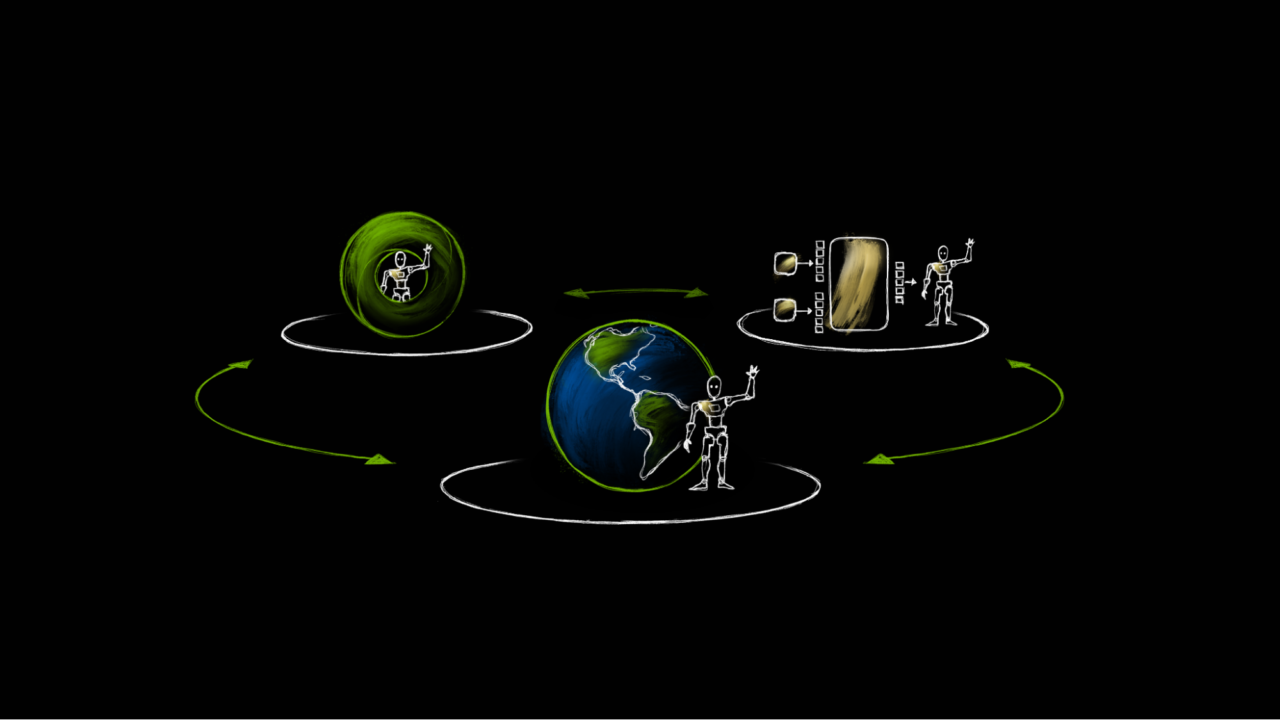
Unlike the expansive datasets available for training Large Language Models (LLMs) and vision-language models, robotics demand understanding complex physical interactions. From the slip of a cup to the bending of cables, these nuanced interactions form the core learning material for AI-driven robots. However, obtaining such data in the real world is prohibitively costly, risky, and often impractical.
Simulation as a Solution
Simulation emerges as a critical bridge, enabling developers to create vast amounts of photorealistic, physics-grounded data. By leveraging simulation environments, developers can train robots in virtual settings, generating extensive experience data at a fraction of real-world costs.
Traditional uses of simulators, primarily for debugging and visualization, have evolved. Now, simulation is integral to the model development process, aiding in generating perception datasets, training reinforcement learning policies, and testing models against rare or adversarial scenarios. This evolution is evident in the increasing involvement of industrial and academic groups in developing robust simulation engines.
Three-Computer Paradigm
The application of simulation in physical AI is structured around a three-computer paradigm: the Training computer, the Simulation computer, and the On-robot computer. Each serves specific roles related to data processing, model training, and deployment within various latency, throughput, and accuracy requirements.
Pattern detected: user workflows shift toward partial automation.
This setup allows for efficient monitoring, analysis, prediction, and control through a continuous data exchange between physical systems and their digital counterparts, enabling a bidirectional feedback loop essential for optimizing AI operations.
Choosing the Right Simulation Engine
Developers frequently face dilemmas when selecting a suitable simulation engine. Key considerations include scalability for synthetic data generation, reinforcement learning support, and environmental fidelity.
Leading simulation engines like MuJoCo, Isaac Sim, and Isaac Lab cater to various requirements, from precise dynamics and contact-rich motion modeling to high-fidelity physics and agent-assisted workflows. Each offers unique capabilities tailored to different robotic applications, from humanoid robots to autonomous vehicles.
MuJoCo and MuJoCo Warp
MuJoCo, known for its speed and accuracy, is essential for modeling systems where physical correctness is vital. Its GPU-accelerated sibling, MuJoCo Warp, optimizes for throughput, enabling large-scale policy training by simulating multiple instances in parallel. This capability is crucial for reinforcement learning tasks involving contact-heavy robot interactions.
Isaac Sim and Isaac Lab
Isaac Sim, built on NVIDIA Omniverse, offers photorealistic rendering and sensor-rich simulations, facilitating digital-twin environments. Isaac Lab extends these capabilities with modular workflows that support reinforcement learning, imitation learning, and sim-to-real deployment.
These frameworks highlight the trend toward scalable, GPU-accelerated physics in robotics, providing stable, repeatable simulations essential for transferring learned behaviors from virtual environments to real-world applications.
Newton Engine
Developed by NVIDIA in collaboration with Google DeepMind and Disney Research, the Newton engine represents a modern, scalable physics layer. Utilizing NVIDIA Warp and OpenUSD, it integrates with frameworks like Isaac Lab, providing researchers with versatile tools for high-throughput robot learning experiments.
Newton’s differentiable physics and modular solver implementations enable adaptive, simulator-agnostic workflows, crucial for advancing physical AI development.
The integration of advanced simulation engines into the development loop signifies a shift in how physical AI systems are trained and deployed. These tools not only streamline data generation but also enhance the fidelity of robotic models, ensuring greater accuracy and efficiency in real-world applications.
Observations indicate that as simulation technologies continue to evolve, their role in AI will expand, underpinning more agile and intelligent systems. Monitoring continues.