

PP-OCRv6 marks a significant advancement in multilingual OCR, offering 50-language support and improved accuracy with flexible deployment options.
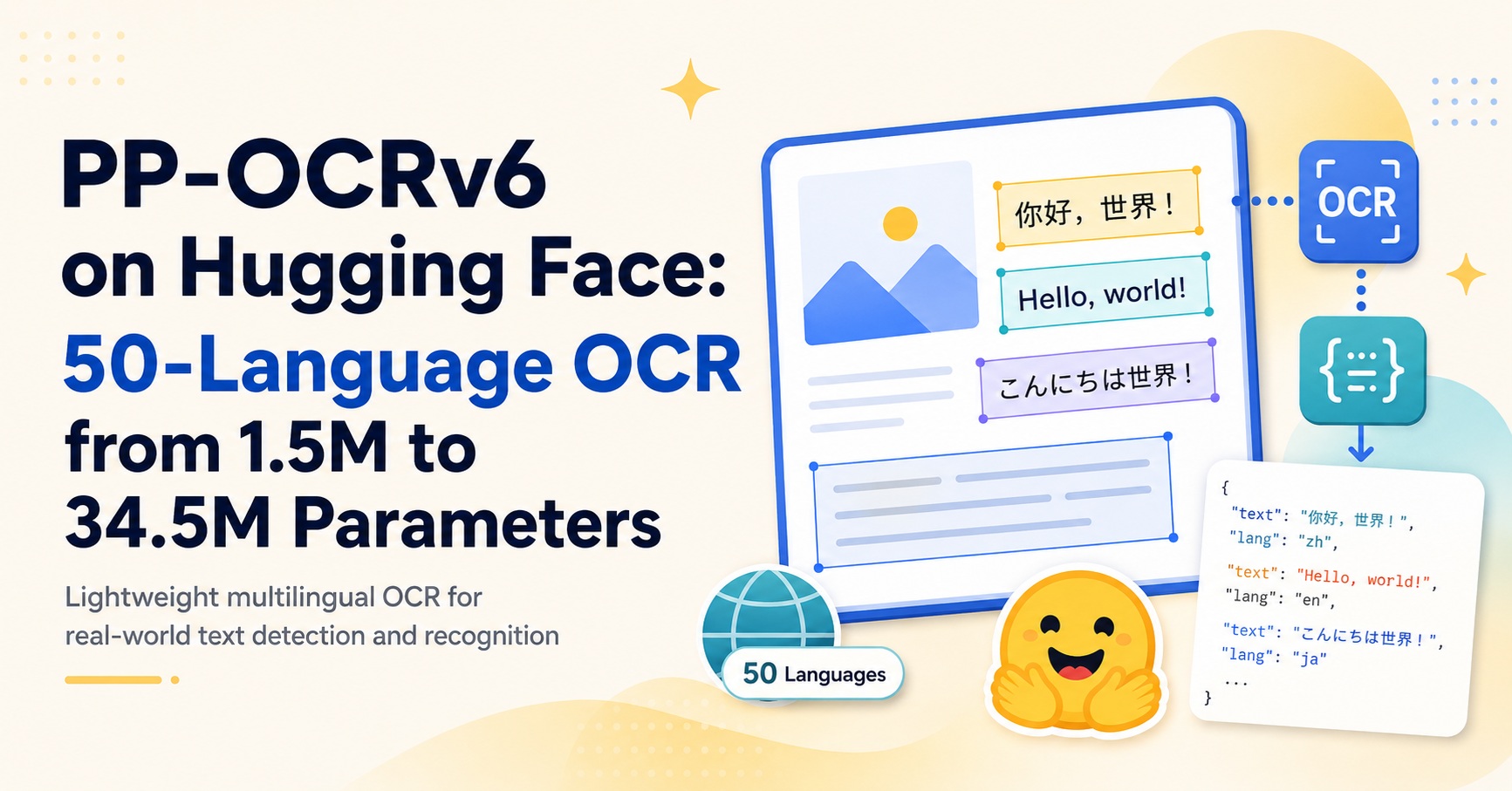
The launch of PP-OCRv6 on Hugging Face heralds a new era in Optical Character Recognition (OCR), particularly in multilingual contexts. PaddleOCR’s latest offering, PP-OCRv6, transforms OCR capacity by scaling from 1.5M to 34.5M parameters across three sizes. Importantly, it supports 50 languages, catering to a wide spectrum of text recognition scenarios.
Advancements in OCR Architecture
PP-OCRv6 introduces significant architectural changes aimed at enhancing OCR accuracy while maintaining adaptability for various deployment environments. The model is diversified into three tiers: tiny, small, and medium. The tiny model suits edge devices and environments where resources are constrained. Meanwhile, the medium model targets accuracy-oriented applications, making it suitable for server-side pipelines and industrial OCR.
The unified backbone, PPLCNetV4, ensures consistency across the model family. This architectural integration simplifies deployment, offering a cohesive system-level function across different model sizes.
Text Detection Enhancements
Text detection, a critical component of OCR, receives a boost with the RepLKFPN upgrade. This lightweight large-kernel feature pyramid network improves multi-scale text detection accuracy while keeping inference efficient. Such improvements matter in real-world scenarios where text may be embedded in complex backgrounds or presented in low-resolution formats.
Recognition Accuracy Improvements
To address challenges in text recognition, PP-OCRv6 integrates EncoderWithLightSVTR. This mechanism leverages local context modeling alongside global attention, significantly enhancing recognition accuracy, especially for dense and multilingual text scenarios.
Multilingual Capabilities
With support for 50 languages, including complex scripts like Simplified and Traditional Chinese, Japanese, and 46 Latin-script languages, PP-OCRv6 caters to diverse multilingual OCR needs. This capability not only broadens its applicability but also reduces reliance on separate models for different languages, streamlining operations in multilingual environments.
System-Level Shift: Automation Layer
The advancements in PP-OCRv6 signify a broader trend towards automation in text processing. By providing a flexible, multilingual OCR solution, PaddleOCR is enabling enhanced automation layers in document processing workflows. The integration of this model with various backends, such as ONNX Runtime and Hugging Face’s Transformers, facilitates seamless adaptation across different technological ecosystems.
Pattern detected: scalability in multilingual text recognition enhances automation in document workflows.
Practical Deployment and Integration
PP-OCRv6’s interoperability across different backends, including Paddle Inference and ONNX Runtime, showcases its adaptability. These integrations are crucial for maintaining performance while allowing users to select the most appropriate technology stack for their specific needs. By providing such flexibility, PaddleOCR ensures that PP-OCRv6 can be effectively integrated into existing systems, minimizing friction in deployment.
Implications for Multilingual Workflows
The integration of PP-OCRv6 in multilingual OCR workflows represents a pivotal shift in how text data is processed and utilized. Enhanced detection and recognition capabilities facilitate more accurate data extraction, enabling more reliable analytics and decision-making processes. As businesses and systems increasingly rely on automated document parsing and data extraction, the capabilities of PP-OCRv6 will likely play a substantial role in shaping future workflows.
By streamlining multilingual OCR processes, PP-OCRv6 contributes to the efficiency and scalability of document management systems, highlighting the ongoing evolution of automation layers in technology infrastructure.
Conclusion: A Step Forward for OCR
PP-OCRv6 stands as a testament to the ongoing advancements in OCR technology. By offering improved accuracy and multilingual support with adaptable deployment options, it sets a new benchmark for OCR systems. The model reflects a system-level automation shift, enhancing the way multilingual text is processed across various applications.
As the OCR landscape continues to evolve, monitoring such developments will remain crucial for understanding their broader impacts on automation and system infrastructure.
Monitoring continues.