

Apple’s new Siri AI extends beyond a voice assistant, acting as an enterprise app layer that integrates with existing workflows. Detecting this shift reveals an evolution toward AI-driven enterprise integration.
Apple’s recent unveiling of the new Siri AI at the Worldwide Developers Conference (WWDC 2026) signals more than just an improvement in their voice assistant capabilities. While consumer-facing changes are evident, the deeper narrative revolves around a significant shift in enterprise technology. Siri is now evolving into a comprehensive AI interface layer for applications, data, and actions across Apple devices, enabling new levels of enterprise integration and automation.
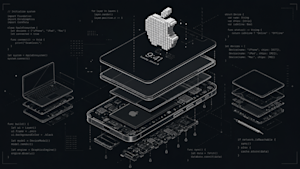
Historically, voice assistants have been limited by their need for explicit command phrases and were often confined to handling simple tasks. However, Apple’s introduction of App Entities, App Intents, App Schemas, and View Annotations enables Siri to seamlessly integrate with enterprise applications. This evolution allows for a natural language interface that empowers users to interact with apps and their content without needing to navigate through them manually. Consequently, this positions Siri as a key facilitator in enhancing productivity and streamlining workflow in enterprise environments.
Siri as an Enterprise Action Layer
The significance of Apple’s strategic direction becomes clear when examining its implications for enterprise developers. The ability to leverage Siri AI as an action and content discovery layer is transformative. By integrating App Intents within their applications, developers can connect apps to Apple’s intelligence framework. This connection facilitates natural language actions, such as summarizing customer records or updating project tasks, without the need for specialized chatbot interfaces.
Such capability drastically reduces the need for developers to create custom solutions for voice interaction, liberating resources and focusing on core application functionality. Enterprise users are empowered to act or retrieve data through voice commands, aligning accessibility with speed and efficiency.
Spotlight Integration for Enterprise Search
Beyond merely acting as a voice assistant, Siri AI’s enhancement includes integration with Spotlight’s semantic index. By contributing app content to the semantic index, developers enable Siri AI to perform actions on indexed content via intuitive commands. This eliminates the rigid structure of previous voice command systems, offering fluid interaction akin to conversational engagement with applications.
The implications are vast for enterprise sectors such as CRM, IT service management, finance, and field operations, where quick access to data and the ability to execute commands can significantly enhance workflow efficiency.
Enhanced Validation and Testing for Reliability
To support this robust integration, Apple introduced the AppIntentsTesting framework. This tool allows developers to validate and test App Intents through the same infrastructure used by Siri, Shortcuts, and Spotlight. This move addresses the crucial need for reliable and repeatable application actions, assuring enterprises of the stability needed for production workflows.
Expansion of Apple’s AI Developer Stack
Apple’s strategic expansion doesn’t stop at Siri. The WWDC26 also introduced updates to the Foundation Models framework. It now supports a wider array of AI models, including those from third-party providers, enhancing developer flexibility. This expansion allows enterprise applications to utilize on-device models for tasks requiring privacy or lightweight processing, and leverage Apple’s Private Cloud Compute for more demanding tasks.
The inclusion of tools for deploying custom models on Apple silicon through Core AI further cements Apple’s focus on empowering developers with a comprehensive AI toolset. This decisively positions Apple within the AI realm by emphasizing privacy and device-centric processing as key differentiators.
Governance and Security Controls
Security considerations are paramount as enterprises weigh the integration of AI systems into their business operations. Apple’s WWDC26 materials detail new governance controls that IT managers can deploy, including management of Siri AI through Apple Intelligence settings. This provides enterprises with the ability to approve or restrict various AI features, ensuring alignment with corporate policies and security standards.
Strategic Enterprise AI Shift
Apple’s approach signals a mature enterprise AI posture that’s not anchored to a single product but a comprehensive ecosystem. By embedding AI capabilities deeply within their operating systems and providing developers with tools to seamlessly integrate within their frameworks, Apple is reshaping the enterprise technology landscape.
The transformation of Siri from a mere assistant into a pivotal component of enterprise applications showcases Apple’s commitment to leveraging AI as a foundational layer for innovation. As enterprises adopt and integrate these capabilities, the tangible outcome will be a shift towards more automated, efficient, and user-centric business environments.
Apple’s strategic move into AI-fueled enterprise integration marks a significant milestone in how technology can enhance organizational workflows, fostering a new era of digital transformation.
Monitoring continues.